

Credit card stacking for franchise funding means opening two to four 0% intro-APR business credit cards in a deliberate sequence and drawing on their combined limits as a short-term capital bridge — instead of waiting on one lender to clear your entire investment, you stagger approvals over 60 to 90 days and use the interest-free window to cover deposits and buildout costs until permanent financing lands.
- Credit card stacking franchise funding uses staggered 0% intro-APR business cards as a bridge, not as primary financing.
- Chase's 5/24 rule blocks approval past five personal cards in 24 months — check this before card two.
- 0% intro windows run 12 to 18 months in 2026; your buildout timeline has to fit inside that window.
- Pair stacking with an SBA loan or a 401(k) rollover so cards cover the timing gap, not the whole investment.
- A stack with no named 90-day payoff date is the version that actually damages your credit.
Why This Matters
Franchise buildouts run on deadlines, not on your lender's calendar. A landlord wants a deposit before your SBA loan closes. A franchisor wants a buildout deposit before permitting starts. Credit card stacking exists to cover that specific gap — the days or weeks where you owe money and your permanent financing hasn't funded yet.
STRIDE Fitness Franchising candidates run into this timing problem constantly: net worth and liquid capital requirements get you qualified, but the cash doesn't always arrive in the order the bills do. Credit card stacking franchise funding is a bridge tool, not a substitute for the permanent financing that actually pays for the studio.
Used correctly in 2026, the stack costs you nothing beyond balance-transfer fees if you clear it inside the 0% window. Used carelessly, it drags your credit into an SBA underwriter's rejection pile mid-process. The difference between the two outcomes is entirely in the sequencing below.
Before You Start
- A registered business entity and EIN. Most 0% intro-APR business cards require you to apply as a business, not an individual — form the LLC or corporation before card one, not after.
- Two years of tax returns or bank statements on hand. Issuers underwrite business cards on personal credit plus reported revenue, so have both ready between applications instead of scrambling.
- A credit score in the high 600s or better across all three bureaus. Cards two and three get capped or declined below that line even when card one approves cleanly.
- The gotcha: applying for cards inside a 30-day window of each other trips manual review at several issuers and can freeze your file mid-stack. Space every application at least 45 to 60 days apart — that one rule decides whether your stack finishes in three months or six.
Map Your Total Capital Need Before You Apply
- List the exact dollar bridge you need — franchise fee deposit, buildout deposit, or working capital gap — separate from money already committed through savings, an SBA loan, or a rollover.
- Pull your current business credit limits from your issuer dashboards or a monitoring tool and calculate how much combined limit across two to four cards covers that gap at 60 to 70% utilization, not 100%.
- Confirm the buildout deposit schedule with your franchise development contact before setting a target number — the payment schedule decides which card needs to fund first, not the total investment figure.
- Write the number down with a date next to it. A bridge without a deadline turns into revolving debt fast.
Expected result: one dollar figure — the total bridge required — and a deadline for when each portion of it needs to hit.
Sequence Your Card Applications
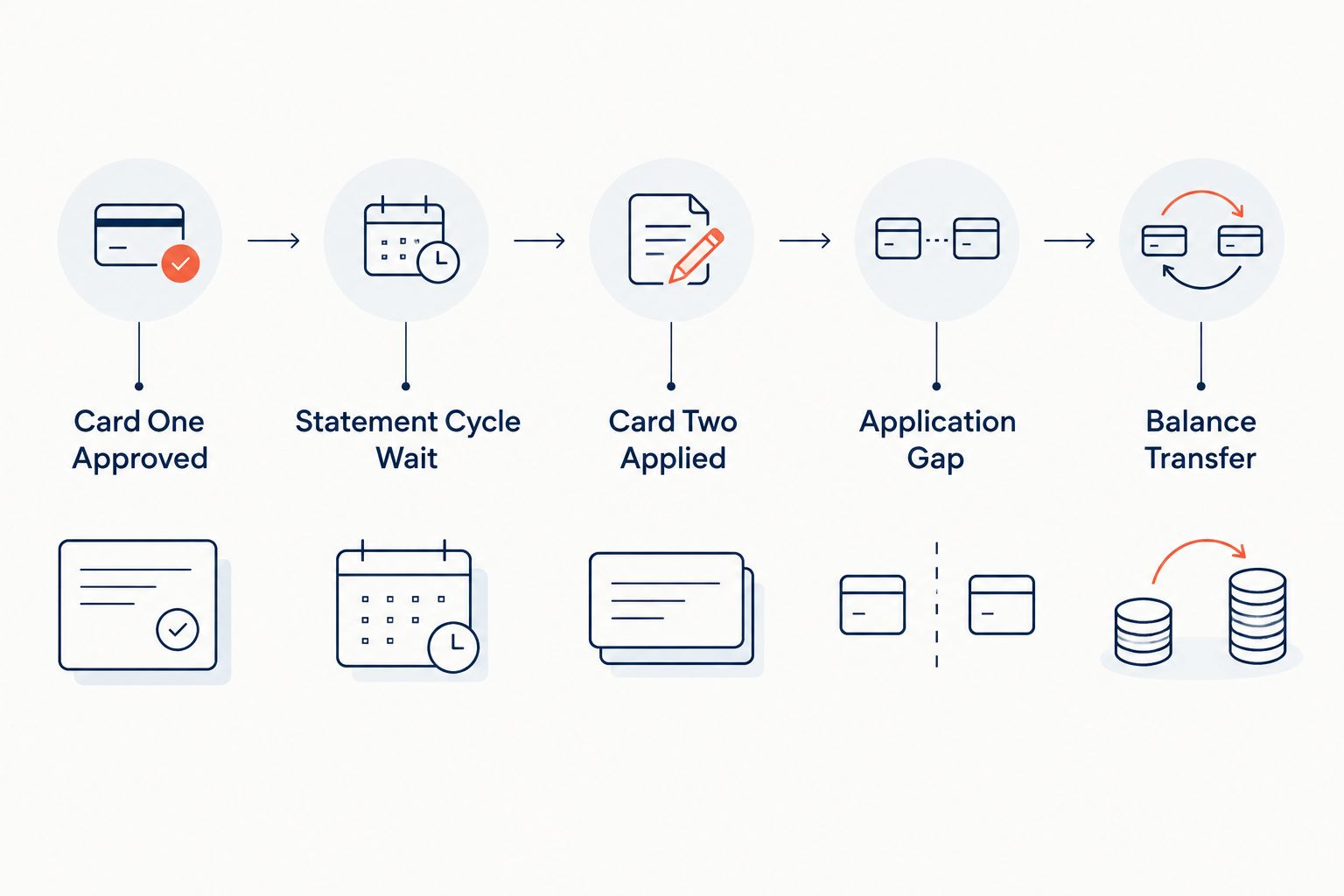
- Apply for card one on whichever card carries the longest 0% intro window you can pre-qualify for; 12 to 18 months is standard across most business card issuers in 2026.
- Wait for the account to post and report — one full statement cycle, roughly 30 days — before submitting the application for card two.
- Space every subsequent application 45 to 60 days apart to avoid the inquiry cluster that triggers manual review.
- Track your personal card count against issuer-specific caps. Chase's 5/24 rule blocks approval if you've opened five or more personal cards in the trailing 24 months, and it catches people mid-stack more often than any other single rule.
Expected result: three to four approved business cards, staggered enough that no single credit pull shows a cluster of hard inquiries.
Stack Balance Transfers To Extend The 0% Window
- At 60 to 90 days out from any card's intro-APR expiration, apply for a balance-transfer card or a fresh intro-APR card sized to absorb the remaining balance.
- Execute the transfer before the original 0% window closes — transferring after standard APR kicks in still gets you the new card's promo rate, but you've already paid full interest on the days in between.
- Budget for the transfer fee. Most issuers charge 3% to 5% of the balance moved — that fee is your real cost of capital here, not the advertised "0%" headline.
Expected result: your interest-free window rolls forward into a new card instead of expiring, buying more runway without a rate hike.
Build The Repayment Bridge Before Draw Down
- Before you draw a single dollar off any stacked card, name the exit — an SBA loan closing date, a completed 401(k) rollover, or a revenue ramp that pays the balance down before the promo rate ends.
- Set a calendar reminder 90 days ahead of the earliest card's 0% expiration. That's your hard deadline to have the payoff source confirmed, not just hoped for.
- Keep utilization under 30% on each card while other financing is still in underwriting — a maxed card can drop your score enough to jeopardize SBA approval mid-process.
Expected result: every stacked dollar has a named payoff source and a date attached to it, not a plan to figure it out later.
Talk Through Your Funding Timeline
See how the numbers line up before you open card one.
Pairing The Stack With An SBA Loan Or A 401(k) Rollover
Card stacking rarely funds an entire franchise investment on its own. It's a bridge that sits alongside one of two more common paths: an SBA loan or a 401(k) rollover into the business, structured as a ROBS.
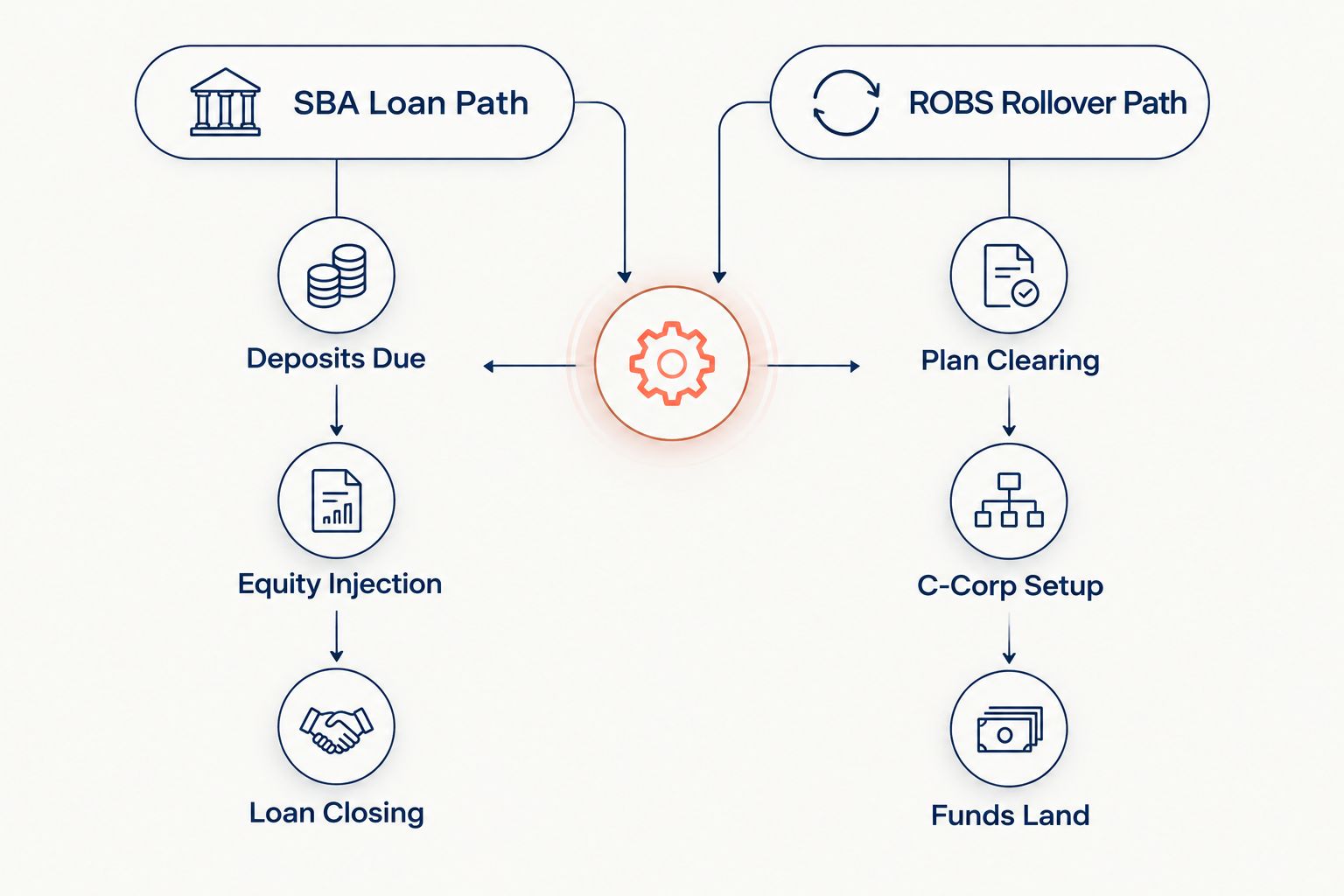
If you're routing the stack toward an SBA loan, the order matters more than the amount. Use the cards to cover costs the SBA loan doesn't reach — permitting fees, deposits due before closing, working capital before revenue starts. Don't let the stack double as the equity injection the lender requires from your own funds. Most SBA lenders run a "sourcing and seasoning" review on the injection and flag borrowed capital used there, which slows or kills the approval outright. The SBA loan application to opening day workflow lays out where the injection sits in the draw schedule so you know exactly what the stack should and shouldn't touch.
If you're routing the stack toward a 401(k) rollover, timing is the whole game. A ROBS rollover moves retirement funds into the franchise entity without a taxable distribution, but the transfer itself takes several weeks to clear plan administration and stand up the required C-corp structure. Use the card stack to cover deposits due before the rollover funds land, then pay the cards off in full the day the rollover completes — not on the promo card's schedule. The 401(k) rollover to franchise ownership workflow walks the ROBS structure step by step.
Troubleshooting
- Card two gets declined despite good credit. Check your inquiry count and the 5/24 math first — issuers decline on velocity, not just score. Wait out a 60-day cooldown before reapplying.
- An SBA underwriter flags the new card debt as a liability that shifts your debt-to-income ratio mid-process. Disclose the stack upfront rather than let the underwriter find it, and time new card applications outside the SBA underwriting window entirely.
- The 0% intro period ends before buildout completes and permanent financing hasn't closed yet. Don't wait for the deadline — execute the balance-transfer step at the 90-day mark, not the 30-day mark.
- Utilization spikes after a draw and your score drops on the next reporting cycle. Utilization above roughly 30% shows up fast on a credit pull; pay down below that line before any other lender checks your file.
- You forget the personal guarantee sitting under the business card. Nearly every business card issued to a new entity carries a personal guarantee, so a franchise that underperforms in year one exposes personal credit and assets, not just the business's. Size the stack to what you could personally repay if that happens.
Customize Your Funding Stack
Card stacking is one bridge among several, and the right size for yours depends on what you're actually solving for. A leaner buildout needs a smaller stack. SBA financing already lined up with a lender who knows the fitness category shortens the underwriting window the stack has to cover. Both scenarios change the target number you set in step one, so revisit it before you apply for card one, not after.
A multi-unit plan changes the math again — a second or third territory means a second bridge on its own timeline, stacked separately from the first. Treat each unit's funding gap as its own workflow rather than one combined pile of cards.
FAQ
What is credit card stacking for franchise funding?
Credit card stacking for franchise funding means opening two to four 0% intro-APR business credit cards in a staggered sequence and using their combined limits to cover deposits and buildout costs before permanent financing closes. It works as a short-term bridge, not as the primary source of capital for the investment.
Is credit card stacking risky for a franchise investment?
Yes — most business cards carry a personal guarantee, so a franchise that underperforms exposes personal credit and assets, not just the business. The risk drops significantly when every stacked dollar has a named payoff date before you draw on it.
How many credit cards can I stack for a franchise?
Most stacks run two to four cards, spaced 45 to 60 days apart to avoid triggering manual review at issuers. Going beyond four cards usually runs into Chase's 5/24 rule or similar issuer-specific caps before it adds meaningful capital.
Can credit card stacking cover my SBA loan equity injection?
Generally no — most SBA lenders review the source of your equity injection and flag borrowed funds, including stacked credit cards, which can slow or kill approval. Use the stack for costs outside the injection, like permitting fees or pre-closing deposits.
How long does a 0% intro APR window last in 2026?
Most business credit cards in 2026 offer 12 to 18 months of 0% intro APR, though the exact term varies by issuer and your credit profile. Balance-transfer cards can extend that window if you move the balance before the original promo period ends.
Does credit card stacking hurt my credit score?
It can, mainly through utilization and inquiry volume — pushing any card above roughly 30% utilization or applying for cards too close together both show up as score drops. Spacing applications and staying below that utilization line keeps the impact small.
Should I combine credit card stacking with a 401(k) rollover?
It works well when the timing lines up — a ROBS rollover takes several weeks to clear plan administration, and a card stack can cover deposits due before those funds land. Pay the cards off the day the rollover completes rather than riding the promo schedule.
Is credit card stacking enough to fund an entire franchise?
No — it's built to bridge a specific timing gap, not to replace an SBA loan, a rollover, or savings as the primary funding source. Franchise investments that rely on stacked cards for the whole amount typically run into utilization and underwriting problems before the studio opens.
One Last Thing
The stack that fails most often isn't the one carrying too much debt — it's the one with no named payoff date. Set your 90-day deadline before you apply for card one, not after card three renews at standard APR. That single habit is the difference between a bridge and a trap in 2026's credit environment.