

Instead of manually checking trainer credentials after interviews and rebuilding the schedule when a candidate fails verification, use a 2026 fitness franchise coach hiring certification workflow that gates every candidate before the offer, onboarding, and first shift.
- A 2026 fitness franchise coach hiring certification workflow should verify credentials before an offer becomes final.
- STRIDE Fitness is best for investors seeking a coach-led boutique concept with cardio, strength training, and recovery.
- Track certification, availability, screening, onboarding, and first-shift eligibility in one hiring record.
- Set credential-expiration reminders for 90 days, 60 days, and 30 days before renewal.
- Use the same verification gates for opening hires and replacement coaches; only the sourcing timeline changes.
Why this matters
A coach-led studio depends on qualified people being ready for the published class schedule. A signed lease and completed build-out do not solve a staffing gap caused by an unverified credential, incomplete onboarding, or availability that does not match the timetable.
Prospective owners evaluating STRIDE Fitness franchise ownership should treat coach staffing as an opening workstream, not a task saved for the final weeks. The concept combines coach-led treadmill cardio, strength training, and a recovery zone, so the people operating the studio must be considered alongside the territory, funding, and site plan.
STRIDE Fitness is best for prospective investors who want a coach-led boutique fitness studio and accept that recruiting, verifying, and retaining coaches is part of operating it. The advantage is a structured, instructor-led member experience. The operational trade-off is that the class schedule cannot run itself when a coach leaves or fails a required verification step.
Before you start
- Get the accepted-credential criteria. Request the current 2026 role requirements, onboarding criteria, and approval process from STRIDE Fitness before publishing the job. Do not infer accepted certifications from another fitness brand.
- Define the shifts you actually need covered. List each recurring coaching block, expected opening coverage, and the minimum availability a candidate must provide. A qualified coach who cannot work the required timetable does not solve the staffing need.
- Choose one system of record. Use an applicant tracking system or a controlled spreadsheet with one row per candidate and access limited to the hiring team.
- Pre-empt the credential-name mismatch. A resume, certificate, and issuer record can use different versions of a candidate's name. Collect the name shown on the credential and the credential identifier before verification so the search does not fail for an avoidable reason.
The 2026 process needs a named owner for every gate. If the franchise owner handles interviews while a studio manager handles verification, record that split before applications arrive.
Build the candidate record
Create the tracking structure before publishing the role. This stops interview notes, certification files, and schedule decisions from living in separate inboxes.
- Add these exact fields: Candidate name, Role, Email, Phone, Required availability, Candidate availability, Certification name, Issuing organization, Credential ID, Expiration date, Verification status, CPR/AED status, Background screening status, Interview status, Onboarding status, and First eligible shift.
- Configure Verification status with controlled values: Not started, Pending, Verified, Mismatch, and Expired. Free-text statuses make it difficult to see who can move forward.
- Configure Interview status with Application review, Phone screen, Practical evaluation, Final review, Offer, and Closed.
- Add calendar reminders for 90 days, 60 days, and 30 days before every recorded expiration date. These are internal renewal prompts, not assumptions about how long any credential remains valid.
- Restrict access to identity documents, screening records, and other sensitive information. Keep interview scoring separate from protected personal information.
Expected result: every candidate has one record showing what has been submitted, what has been independently checked, who owns the next action, and whether the person can be scheduled.
Configure the application gate
The application should collect enough information to reject an obvious mismatch without asking candidates to upload unnecessary records before the first screen.
- Publish the schedule blocks that need coverage. Use specific days and times from your operating plan rather than asking whether the applicant has flexible availability.
- Ask for Certification name, Issuing organization, Credential ID, and Expiration date as separate fields. Do not accept certified trainer as a complete answer.
- Add a required question asking whether the candidate can complete the franchisor's role-specific onboarding before the planned first shift.
- Ask whether the applicant currently holds CPR/AED credentials only when that requirement appears in the role criteria supplied for your studio.
- Send complete applications to Application review. Move incomplete credential records to Pending and request the missing field before scheduling a practical evaluation.
- Compare Candidate availability with Required availability. Close candidates who cannot cover the role you posted, even when their experience is otherwise relevant.
Expected result: the interview list contains candidates whose stated credential and availability match the written 2026 role criteria. Verification still comes later; the application gate is a screen, not proof.
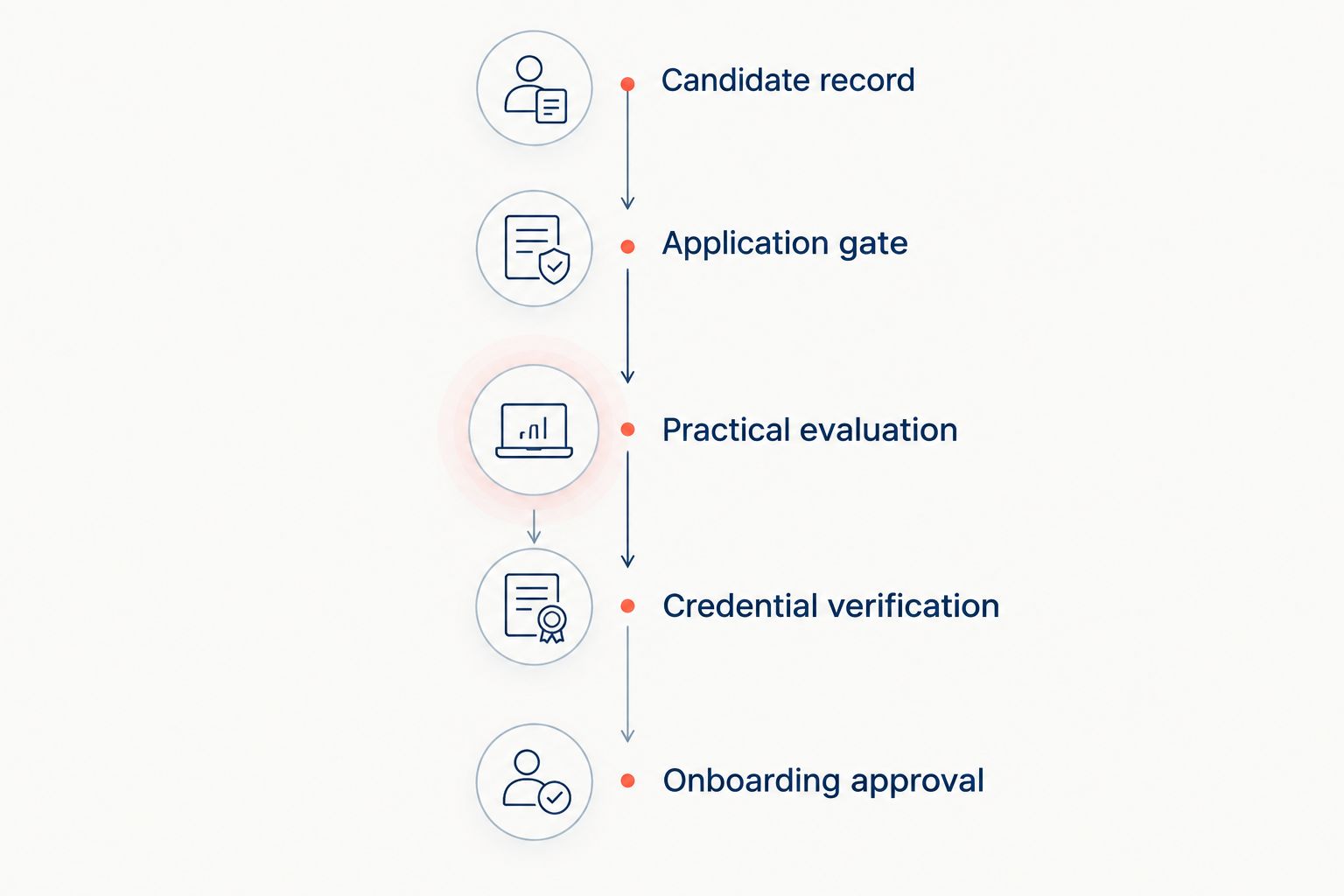
Run the practical evaluation
Certification confirms that a credential was issued; it does not replace a role-specific assessment. Use the same evaluation structure for every finalist applying to the same position.
- Create a scorecard with Instruction clarity, Safety cues, Timing, Exercise modification, Member communication, and Schedule fit.
- Give each finalist the same coaching prompt and preparation information. Do not change the task because one candidate has more industry experience.
- Assign at least 2 evaluators when your hiring team allows it. Have each evaluator submit a scorecard before discussing the candidate so one opinion does not rewrite the room.
- Record job-related evidence under each scorecard field. Avoid impressions such as good energy when the decision needs to explain whether the candidate can deliver the required format.
- Move passing candidates to Final review. Mark unsuccessful candidates Closed and retain records according to the employment and privacy rules that apply to your business.
Expected result: every finalist reaches verification with a completed, comparable assessment rather than an informal interview verdict.
Verify credentials and screening
Credential verification is the hard gate in the fitness franchise coach hiring certification process. A document supplied by the applicant is evidence to check, not the final verification source.
- Use the issuing organization's official verification method. Match the candidate's credential name, identifier, status, and expiration date against the issuer's record.
- Record the check date and result under Verification status. Do not copy sensitive information into general interview notes.
- Mark unexplained differences Mismatch and ask the candidate to correct the record or provide the information needed for another search. Do not silently edit the credential identifier to force a match.
- Verify CPR/AED status separately when it is part of the written role requirement. Its issuer and expiration date belong in distinct fields because it is not the same credential as the trainer certification.
- Start any legally permitted and required background screening at the correct stage for your jurisdiction and company process. Use the required disclosures, authorizations, and decision procedures; employment screening rules are not interchangeable across locations.
- Make the offer conditional on every written hiring requirement that remains open. Remove the condition only after the associated field shows an approved result.
Expected result: the final candidate has documented credential verification, completed role assessment, confirmed schedule fit, and the screening status required for the position.
Complete onboarding and schedule access
Hiring is not finished when the candidate accepts the offer. The final gate is role-specific onboarding and documented authorization to coach independently.
- Assign the required learning, studio procedures, and format preparation from the approved onboarding plan.
- Set Onboarding status to Assigned, In progress, Needs review, or Approved.
- Keep the candidate off solo shifts while the status is Assigned, In progress, or Needs review.
- Record the approving manager and approval date when onboarding is complete.
- Enter First eligible shift only after verification, screening, and onboarding show the required result.
- Audit the opening schedule for uncovered blocks and single points of failure. Assign backups where your staffing plan supports them rather than assuming every coach will remain available.
Expected result: every person on the live coaching schedule has cleared the same documented gates and has an explicit first eligible shift.
Replace a coach when the schedule is already live
A replacement hire uses the same controls, but sourcing begins from a known schedule gap rather than an opening forecast. Do not remove verification steps because classes are already on the calendar.
| Workflow | Best for | Advantage | Constraint |
|---|---|---|---|
| Opening-team hiring | A studio preparing its initial schedule | You can recruit several roles against one operating plan | Demand and schedule patterns are not yet proven |
| Replacement hiring | An operating studio with a departing coach | The uncovered shifts and required availability are known | Time pressure can tempt managers to skip a gate |
- Change the departing coach's future availability without deleting the historical staffing record.
- List the exact uncovered shifts under Required availability.
- Reopen qualified past applicants only after confirming their current interest, availability, and credential status.
- Run the same practical evaluation, primary verification, screening, and onboarding gates used for opening hires.
- Use approved temporary coverage until First eligible shift is populated for the replacement. Do not convert urgency into an exception.
Troubleshooting
The issuer search returns no result
Check the credential name, identifier, issuing organization, and the name printed on the credential. Mark the record Pending while the candidate supplies corrected information. A missing search result is not a verified credential.
The credential expires near the planned first shift
Follow the written role criteria and ask for renewal evidence when required. Record the current expiration date exactly as verified, then keep the 90-day, 60-day, and 30-day reminders attached to the replacement date once confirmed.
The candidate passes the evaluation but lacks required availability
Do not reshape the posted role around a candidate unless the operating schedule supports the change. Keep the person in a future-candidate pool only with permission and a defined retention period.
Screening remains open while onboarding starts
Label the offer and onboarding status accurately. Completing training does not override an unresolved hiring condition, and the candidate does not receive a solo shift until every required gate closes.
A manager updates the schedule outside the hiring record
Make First eligible shift the controlling field for schedule access. Audit the roster against that field before publishing changes so an informal message cannot bypass verification.
Review the ownership model
See how coach-led cardio, strength training, and recovery fit the franchise concept.
Customize your workflow
A single-studio owner can manage the process with one controlled candidate table and one renewal calendar. A multi-unit operator needs location fields, shared candidate permissions, and a clear rule identifying which manager can approve First eligible shift for each studio.
A prospective owner with coaching experience still needs documented gates. The ownership guide for personal trainers and coaches explains the shift from coaching work to franchise ownership, while this workflow covers the staffing control needed after that decision.
For a 2026 STRIDE Fitness franchise plan, connect hiring milestones to the opening plan without inventing fixed lead times. Set internal due dates from the territory's actual development schedule, then place credential verification and onboarding before the first published class.
FAQ
What certification does a fitness franchise coach need in 2026?
The coach needs a credential accepted by the specific franchisor and role criteria in effect in 2026. Confirm the accepted issuing organizations and any separate CPR/AED requirement before publishing the job.
How do I verify a fitness coach certification?
Use the issuing organization's official verification method and match the credential name, identifier, status, and expiration date. A certificate uploaded by the candidate should be checked against the issuer's record.
Should certification be checked before or after the interview?
Collect certification details during the application, then complete independent verification before the offer becomes final. This avoids spending verification time on candidates who fail the availability or practical-evaluation gates.
Can an experienced trainer skip franchise onboarding?
No candidate should skip required role-specific onboarding because of prior experience. Base credentials, practical evaluation, and franchisor onboarding answer different hiring questions.
What should a coach hiring tracker include?
Track candidate identity, availability, credential details, verification status, screening status, interview stage, onboarding status, and first eligible shift. Assign an owner and next action to every open gate.
How do I prevent trainer certifications from expiring unnoticed?
Record the verified expiration date and schedule internal reminders for 90 days, 60 days, and 30 days before it. Update the record only after the renewed credential has been checked through the issuer.
Does replacement hiring use a different certification process?
Replacement hiring uses the same credential, screening, evaluation, and onboarding gates as opening-team hiring. The difference is that the replacement workflow starts with specific uncovered shifts and greater time pressure.
Can I schedule a coach while verification is pending?
Do not assign a solo shift while a required credential or hiring condition remains pending. Populate the first eligible shift only after every required gate reaches its approved status.
One last thing
Do not measure the 2026 workflow by how quickly a candidate signs an offer. Measure it by whether the schedule contains coaches whose availability, verification, screening, and onboarding records are complete before their first eligible shift.
For a STRIDE Fitness territory, the hiring system should be designed before applications arrive. That single decision turns coach staffing from a collection of emails into an operating process with visible gates.