

Negotiating a new territory, fee schedule, and lease every time you want to open a second STRIDE Fitness studio is slow and puts you at the back of the line behind other candidates. A multi-unit franchise development agreement fixes that upfront: it locks your total unit count, territory map, and opening deadlines into one signed document before you break ground on studio one, so studio two and three become execution, not renegotiation.
- A multi-unit franchise development agreement sets unit count, territory boundaries, and opening deadlines in one document instead of one negotiation per store.
- STRIDE Fitness awards multi-unit development rights to operators with proven single-unit economics or upfront development capital.
- Missing a Development Schedule deadline can trigger de-scheduling, which strips exclusive rights to territories you haven't built yet.
- Development fees are commonly credited against future per-unit franchise fees, reducing the cash needed for unit two and three.
- Financing each additional unit on its own loan beats stretching one facility across three studios in 2026.
Why this matters
Most franchisees who want more than one location default to signing a second single-unit agreement whenever they're ready. That works, but it means re-qualifying, re-negotiating territory, and competing with new candidates for the same map every single time.
A multi-unit franchise development agreement, often called an Area Development Agreement or ADA, reverses that order. You commit to a development schedule up front — say, three studios in a defined territory over a set number of years — and the franchisor reserves that territory exclusively for you while you execute. In 2026, this is the standard path for operators who already know they want to build a small portfolio rather than test the water with one unit.
The trade-off is real: you're committing to open studios you haven't financed yet, on a timeline you don't fully control. Get the schedule wrong and you're the one holding a missed deadline, not the franchisor.
Before you start
- Proof you can operate one unit before you're trusted with three. Most systems, including STRIDE Fitness, want to see a single studio hitting its unit economics targets, or a financial statement strong enough to open multiple units simultaneously, before awarding development rights.
- Updated Franchise Disclosure Document (FDD) review specific to development terms. The FDD section on area development is separate from the single-unit franchise agreement — read Item 12 (territory) and the development schedule exhibit before you sign anything.
- The gotcha: development deadlines are binding, not aspirational. Sign for three units in five years and open only one, and the franchisor can de-schedule the remaining territory and reassign it. Build a real calendar before you sign, not after.
Confirm eligibility for multi-unit development
- Request the current territory map for the market you want. Ask specifically which zones are open, reserved, or under a prior Right of First Refusal.
- Submit an updated personal financial statement showing net worth and liquid capital sufficient for the total unit count you're requesting, not just unit one. Development lenders and franchisors both size this against the full commitment.
- If you already operate a STRIDE Fitness studio, request a performance review of that unit — average unit volume and payment history typically factor into whether you're awarded additional territory.
Expected result: a written development proposal naming your candidate territory, proposed unit count, and a draft timeline, before any agreement is drafted.
Negotiate the development schedule
- Fix the number of units you're committing to. Two is common for a first development deal; three or more usually requires demonstrated multi-unit experience or larger liquid capital.
- Set the opening deadline for each unit individually — unit one by month 12, unit two by month 24, for example — rather than one deadline for the whole package. Individual deadlines give you room if one site takes longer to permit.
- Confirm the territory boundaries in writing, including whether the map is exclusive or protected only against company-owned locations.
- Review whether the agreement includes a Right of First Refusal on adjacent territory — this can obligate you to develop nearby zones before the franchisor offers them to anyone else.
Expected result: a development schedule exhibit listing each unit, its territory, and its deadline, attached to the agreement before signature.
Execute the area development agreement
- Sign the Area Development Agreement alongside (or ahead of) the individual Franchise Agreement for unit one. These are two separate contracts even though they're negotiated together.
- Pay the development fee. In most franchise systems this is credited, in whole or in part, against the individual franchise fee owed when you sign the Franchise Agreement for each subsequent unit — confirm the credit structure in writing before you pay.
- Calendar every deadline from the development schedule into your own project tracker, not just the franchisor's file. The franchisor is not obligated to remind you before a deadline passes.
Expected result: a signed ADA, a signed Franchise Agreement for unit one, and a funded development fee, with unit one's site search already underway.
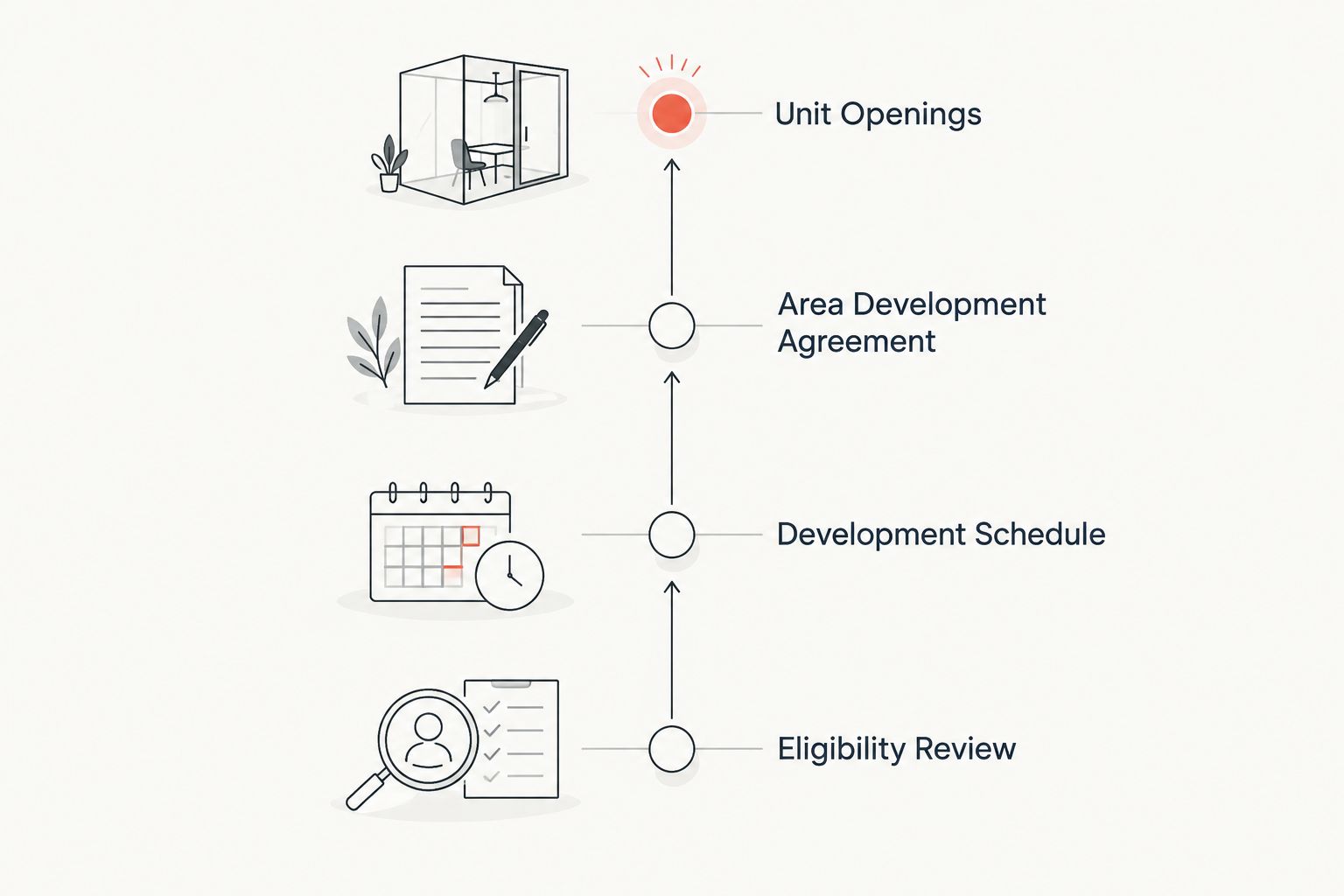
Converting a single-unit agreement vs. signing multi-unit from day one
Two adjacent paths lead to the same place, and the workflow differs slightly for each.
Path A — you already operate one studio and want to add territory. You'll go through the eligibility review above using your existing unit's performance data, then negotiate a development schedule for additional territory only. Your existing Franchise Agreement stays untouched; the ADA is a new, separate contract layered on top.
Path B — you're a first-time franchisee who wants multiple units from the start. You'll negotiate the ADA and the Franchise Agreement for unit one simultaneously, before you have any operating history with the brand. Franchisors typically require stronger liquid capital and net worth for this path, since there's no track record to lean on. Review best fitness franchises for multi-unit operators before choosing this route — the capital bar is materially different from opening one unit.
Fund each additional unit
Don't finance unit two off the cash flow of a studio that hasn't broken even yet. Structure financing per unit:
- SBA 7(a) loans are commonly used for build-out and equipment on each new location, underwritten separately per unit.
- A HELOC or 401(k) rollover can cover a down payment on unit two while an SBA loan covers the balance — check the SBA loan application workflow before you commit to a development schedule that assumes financing you haven't secured.
- Build a 60-90 day capital buffer per unit into your development schedule negotiation — construction delays are the most common reason development deadlines slip in 2026.
Troubleshooting
- You're behind on the Development Schedule for unit two. Contact the franchisor before the deadline, not after. Most agreements allow a written extension request; missing the date without notice is what triggers de-scheduling.
- Financing for unit two fell through. Revisit whether unit one's actual performance supports a smaller loan or a different lender before assuming the whole development deal is dead — a delayed unit two beats a defaulted development schedule.
- A competing candidate wants the adjacent territory you haven't developed yet. This is exactly what the Right of First Refusal clause protects against — confirm your ADA includes it before someone else's development schedule overlaps yours.
- The development fee credit didn't apply the way you expected. Get the credit mechanism in writing at signing; verbal understandings about fee credits are the single most common post-signing dispute in area development deals.
- Site selection for unit two is taking longer than the deadline allows. Real estate timelines rarely match paper deadlines — negotiate individual, staggered opening deadlines per unit at the negotiation stage, not after you're already behind.
See what multi-unit territory looks like
Review open STRIDE Fitness territories before you negotiate a development schedule.
Customize your workflow
Once the ADA is signed, the workflow branches depending on how hands-on you plan to be across units. Semi-absentee owners run a different staffing and oversight model across two or three studios than an owner-operator running one — review best fitness franchises for semi-absentee ownership before you finalize your development schedule staffing plan, since the deadline math changes if you're hiring general managers for each unit rather than running one yourself.
If your background is in multi-unit retail or restaurant operations, the development schedule negotiation will feel familiar — the core difference in fitness is smaller footprints and faster build-out timelines per unit.
FAQ
What is a multi-unit franchise development agreement?
It's a single contract, often called an Area Development Agreement, where a franchisee commits to opening a set number of units in a defined territory by specific deadlines, in exchange for exclusive development rights to that territory.
How is a development agreement different from a franchise agreement?
The Franchise Agreement covers one specific unit's operating terms. The development agreement sits above it, committing you to open multiple units on a schedule before each individual Franchise Agreement is signed.
What happens if I miss a development schedule deadline?
Franchisors can de-schedule the undeveloped territory, meaning you lose exclusive rights to open there. Most agreements allow a written extension request before the deadline, which is the safer move than missing it silently.
Do I need to already own one STRIDE Fitness studio to sign a development agreement?
No. Some operators sign a development agreement for multiple units from day one, though this path typically requires stronger liquid capital and net worth since there's no operating history to point to.
Is the development fee separate from each unit's franchise fee?
The development fee is typically paid once at signing and commonly credited against the individual franchise fee owed for each subsequent unit, though the exact credit structure should be confirmed in writing before signing.
How many units are typical for a first multi-unit development agreement?
Two units is common for a first development deal in the boutique fitness segment as of 2026. Three or more usually requires demonstrated multi-unit experience or larger available capital.
Can I finance all my units with one loan?
You can, but structuring financing separately per unit, such as an SBA loan for each build-out, reduces the risk of one underperforming unit dragging down your ability to fund the next one on schedule.
What is a Right of First Refusal in a development agreement?
It's a clause giving you first option on adjacent territory before the franchisor offers it to another candidate. Some agreements pair this with an obligation to develop that territory within a set window, so read it closely before signing.
One last thing
The clause candidates skim past fastest is the Right of First Refusal, and it's the one that causes the most regret in 2026. Signing it can obligate you to develop adjacent territory on the franchisor's timeline, not yours — read that section before you read the fee schedule, not after.