

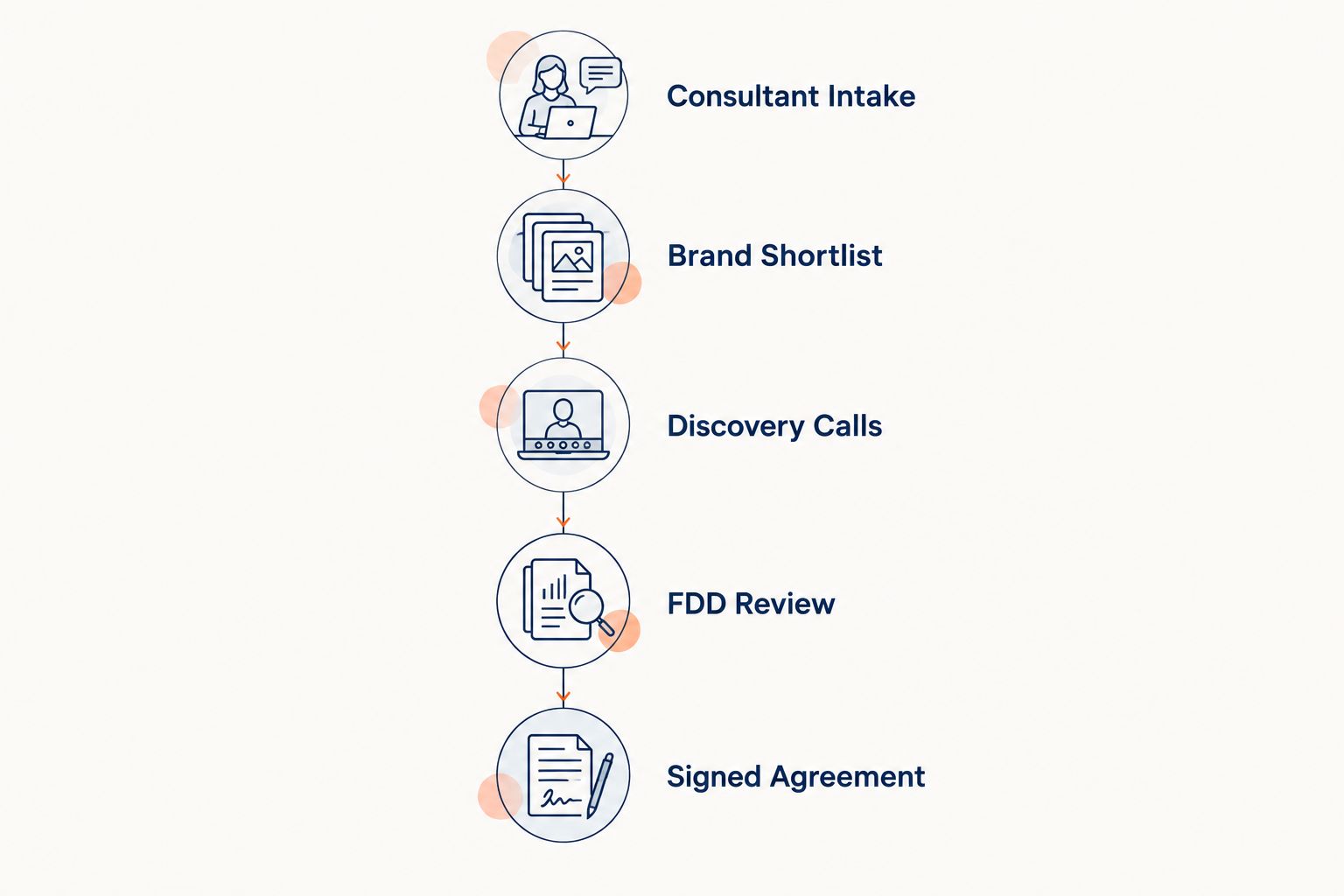
Instead of researching forty fitness franchise brands one at a time and guessing which ones fit your capital, a franchise consultant matching process filters the field to a handful of fits, then routes you through discovery calls, Franchise Disclosure Document (FDD) review, and a signed franchise agreement in a defined order instead of a scattered one.
- A franchise consultant matching process narrows dozens of brands to a short list based on your capital and goals, then routes you through discovery calls, FDD review, and signing.
- Consultants are paid by the franchisor you sign with, not by you — treat every recommendation as a lead, not neutral advice.
- The FTC Franchise Rule requires franchisors to hand over the FDD at least 14 calendar days before you sign or pay any fee.
- STRIDE Fitness Franchising runs a direct-to-franchisor path with named stages, including a formal Confirmation Day before territories are awarded.
- Skip the consultant layer if you already know the fitness franchise category and just need financing and territory data.
Why This Matters
Most first-time franchise candidates in 2026 start the same way: a Google search, a handful of brand websites, and no way to score one opportunity against another. A franchise consultant matching process exists to close that gap — it's a structured intake, not a sales pitch, and it's free to you because the franchisor pays the placement fee.
That funding structure matters more than most candidates realize. It means the consultant's incentive is to get you signed somewhere in their network, not necessarily with the best fit for your goals. Understanding the sequence — STRIDE Fitness Franchising runs a version of it directly, without the consultant layer — lets you use the process without being used by it.
Before You Start
- Net worth and liquid capital figures, in writing. Consultants and franchisors both screen on this before scheduling a first call, and vague answers slow everything down. Check where a brand lands on liquid capital requirements across fitness franchises before you take the call.
- A short list of hard criteria. Investment ceiling, semi-absentee versus owner-operator, and which categories you'll actually consider — walking in without these invites a shortlist built around the consultant's convenience, not yours.
- The gotcha: a franchise consultant is paid a placement fee by the franchisor you sign with, typically drawn from your franchise fee at closing. The shortlist you receive reflects which brands work with that consultant's network — not the entire fitness franchise market. Cross-check independently before you narrow anything.
Set Up Your Consultant Intake
- Complete the consultant's intake questionnaire — this covers liquid capital, net worth, target market, timeline to open, and industry preference.
- Book the discovery call, where the consultant asks follow-up questions on your goals and disqualifies brands outside your stated capital range.
- Ask directly: "Which portfolio are you paid to represent?" A consultant working a fixed network of franchisors will say so if pressed, and the answer tells you how wide the shortlist actually is.
Expected result: a written shortlist of three to six brands matched to your capital range and target market.
Configure Your Brand Shortlist
- Request the Franchise Disclosure Document (FDD) for every shortlisted brand — a legitimate franchisor sends it without hesitation, and hesitation here is itself a signal.
- Score each brand against the same three variables side by side: franchise fee, estimated build-out cost, and royalty rate.
- Cut the list to two or three brands before contacting franchisor development teams directly. Running discovery calls across six brands at once slows the whole process without improving decision quality.
Expected result: two or three franchisors on your list, backed by their own FDDs, ready for direct contact.
Run Discovery Calls With Franchisors
- Schedule a call directly with each brand's franchise development team — not the consultant — for your top two or three finalists.
- Ask for Item 19 of the FDD if it wasn't in your first packet. This is the financial performance representation section, and not every franchisor publishes one.
- Request a reference list of current owners and call at least three of them without the franchisor on the line.
Expected result: direct answers on unit economics and territory availability from the people who actually award the franchise, not the matchmaker.
Validate Through FDD Review And Legal Counsel
- Send the FDD to a franchise attorney before signing anything — this step sits outside the consultant relationship and is worth the cost every time.
- Confirm the 14-day waiting period required under the FTC Franchise Rule: you must receive the FDD at least 14 calendar days before signing the franchise agreement or paying any money.
- Compare the franchise fee and royalty rate stated in the FDD against what the consultant told you verbally. A discrepancy here is a stop sign, not a footnote.
Expected result: a reviewed FDD, a legal opinion in hand, and confirmation that the pitched numbers match the paperwork.
Move From Discovery Day To Signed Agreement
- Attend the franchisor's Discovery Day (in person or virtual), where leadership decides whether to award you a territory.
- Line up financing before you're awarded a territory, not after. SBA loan draws move slower than most candidates expect, and closing that gap late in the process stalls the award.
- Sign the franchise agreement and pay the initial franchise fee only after your attorney has reviewed the final version — not the draft that circulated earlier.
Expected result: a signed franchise agreement, an awarded territory, and a financing plan already moving.
Skip The Consultant: Direct-To-Franchisor Workflow
Some candidates skip the matching step entirely and go straight to a franchisor's own development team. This works when you've already narrowed the category — fitness, specifically — and just need financing and territory data, not brand discovery.
STRIDE Fitness Franchising runs this path with named stages instead of a generic sales funnel: an initial call, a deeper qualification conversation, item review, then a formal Confirmation Day before a territory is awarded to a candidate. First-time investors weighing this route against a broader consultant search should read what a fitness franchise opportunity built for a first-time buyer actually requires before picking a lane.
Direct-to-franchisor works when you've already picked the category; consultant matching earns its keep when you haven't.
Compare The Direct Path To STRIDE
See how territories and the awarding process work without a consultant layer.
Troubleshooting
- The consultant only shows brands from one portfolio group. Ask which franchisors pay them and independently research brands outside that network before deciding anything is off the table.
- Your net worth or liquid capital falls short of a brand's stated minimum. Get the exact figure in writing before the first discovery call, not after you've fallen for a pitch.
- No territories are open in your target market. This kills deals late and wastes weeks. Confirm territory availability on the intake call, not after FDD review.
- The FDD has no Item 19. Not every franchisor publishes financial performance data. Push for owner references instead and build your own unit economics estimate from what they tell you.
- A spouse or co-investor isn't aligned on the decision. Bring them into the discovery call stage, not the signing stage. Misalignment is cheaper to surface early than at the closing table.
Customize Your Workflow
Run financing in parallel with brand matching instead of starting it after you've narrowed a shortlist — approval timelines on outside financing often run longer than the matching-to-signing sequence itself. Semi-absentee candidates should add a step scoring each finalist's on-site staffing model before Discovery Day, since that variable changes the unit economics more than the franchise fee does. Career changers coming from a fixed schedule should stress-test the same question against their actual weekly availability, not their intended availability, before signing anything in 2026.
FAQ
What is a franchise consultant matching process?
It's a structured intake where a consultant scores your capital, goals, and market against a set of franchise brands and returns a shortlist. The consultant is paid by the franchisor you eventually sign with, not by you.
Is a franchise consultant free to use?
Yes, in most cases — the placement fee comes from the franchisor at closing, drawn from your franchise fee. That's exactly why the shortlist reflects the consultant's network, not the full market.
How long does franchise consultant matching to signed agreement take?
Timelines vary by brand, financing method, and territory availability, so no single figure applies across candidates. The sequence itself — intake, shortlist, discovery calls, FDD review, signing — stays consistent regardless of how long each stage takes.
Do I have to use a consultant to buy a fitness franchise?
No. Going direct to a franchisor's development team skips the matching layer entirely and works well once you've already narrowed the category, as STRIDE Fitness Franchising's own process shows.
What is Item 19 in a Franchise Disclosure Document?
Item 19 is the financial performance representation section of the FDD. Not every franchisor includes one, and its absence should push you toward owner reference calls instead.
How many days before signing must I receive the FDD?
The FTC Franchise Rule requires franchisors to provide the FDD at least 14 calendar days before you sign a franchise agreement or pay any money. This applies regardless of whether a consultant is involved.
Can a franchise consultant show me brands outside their network?
Some will if asked directly; many won't volunteer it. Asking which portfolio they're paid to represent is the fastest way to find out how wide your actual shortlist is.
What happens on Discovery Day?
Discovery Day is where a franchisor's leadership meets finalist candidates and decides whether to award a territory. It typically follows FDD review and precedes the signed franchise agreement.
One Last Thing
The 14-day FDD waiting period under the FTC Franchise Rule isn't a formality most candidates think about — it's the one hard stop in the entire sequence that exists to protect you from signing under pressure, and skipping past it (or letting a consultant rush you through it) is the single most common way candidates end up in a franchise agreement they didn't fully read.