

Pulling a lump sum from a home equity line and wiring it into a franchise down payment without a documented workflow is how closings get delayed at the SBA underwriting stage. The fix is sequencing the draw, the seasoning period, and the paper trail before you ever submit a loan application, so the money looks like capital, not a mystery deposit.
- A HELOC franchise down payment works when the draw is seasoned 60-90 days before the SBA loan application, not wired in the week of closing.
- Most HELOC lenders cap combined loan-to-value at 80-85% of home equity, which sets your real ceiling before you count on it as a down payment.
- SBA 7(a) lenders typically require a 10-15% equity injection into the franchise, and a HELOC can fund that injection if it is documented as your own funds.
- Pair the HELOC with a source-of-funds letter and bank statements showing the draw settled before the loan package goes to underwriting.
- STRIDE Fitness candidates using a HELOC still go through the same qualification and awarding process as cash buyers.
Why this matters
SBA underwriters flag large, unexplained deposits. A HELOC draw that lands in your checking account two weeks before closing reads exactly like that unless you can show where it came from and that it's been sitting there. Get the sequence wrong and you're not looking at a rejection so much as a 30-60 day delay while the lender re-verifies the source of funds, which can blow past your target opening date if a construction timeline is already locked in.
The home equity line of credit itself isn't the risk. The timing and documentation are. Handle both correctly and a HELOC is one of the more straightforward ways to fund a franchise down payment in 2026, especially for candidates whose liquid capital is thin but whose home equity is solid.
Before you start
- Home equity and a lender relationship. You need enough equity above your existing mortgage balance to qualify for a line, and a bank or credit union willing to underwrite a HELOC against an owner-occupied property — not every lender will if you disclose the funds are going into a business.
- A rough franchise budget. Know your target equity injection before you open the line. Opening a HELOC for more than you need just adds carrying cost and interest exposure on a line you didn't have to draw.
- The gotcha: most SBA lenders will not count a HELOC draw as "your own funds" if it lands in your account inside the 60 days before you submit the loan application. Open the line and pull the draw early, then let it sit and season, or you'll be re-explaining the deposit mid-underwriting.
Set up the HELOC
- Apply for the home equity line through your bank or credit union, specifying the credit limit you want approved, not the amount you plan to draw immediately.
- During underwriting, the lender will order an appraisal and calculate your combined loan-to-value — your first mortgage balance plus the new line, divided by the appraised value. Most lenders cap this at 80-85%.
- Once approved, you'll get a draw period, typically 5-10 years, during which you can pull funds as needed rather than taking the full limit at once.
- Sign the closing documents and confirm the line is active by checking your online banking portal for the new account showing an available balance.
Expected result: an active HELOC with an available credit limit, sitting undrawn until you're ready to move on the franchise timeline.
Draw the funds and let them season
- Draw the amount you've budgeted for your equity injection — not the full line limit — and route it into a dedicated checking account, not your everyday spending account.
- Leave the funds untouched for 60-90 days before submitting your SBA loan application. This is the single most important step in the whole workflow.
- Save the HELOC statement showing the draw date and the destination account. You'll need this exact document later.
- Track the account balance monthly so the statement trail shows the funds sitting there, not churning through purchases.
Expected result: a checking account with a documented, seasoned balance that matches your planned equity injection, backed by a HELOC statement showing exactly when and how it arrived.
Document the source for your SBA lender
- Request a source-of-funds letter from your HELOC lender confirming the line, the draw amount, and the date it was disbursed.
- Pull three consecutive months of bank statements for the account holding the funds, with the HELOC deposit clearly visible and no large unexplained transactions afterward.
- Submit both alongside your SBA loan application as part of the use of proceeds and equity injection section, not as a separate afterthought.
- Confirm with your SBA lender before submission whether they classify a HELOC draw as a loan (debt) or as equity — this affects your debt-to-income calculation and some lenders weigh it differently.
Expected result: an SBA loan file where the equity injection is fully sourced, seasoned, and pre-cleared with your lender before an underwriter ever asks the question.
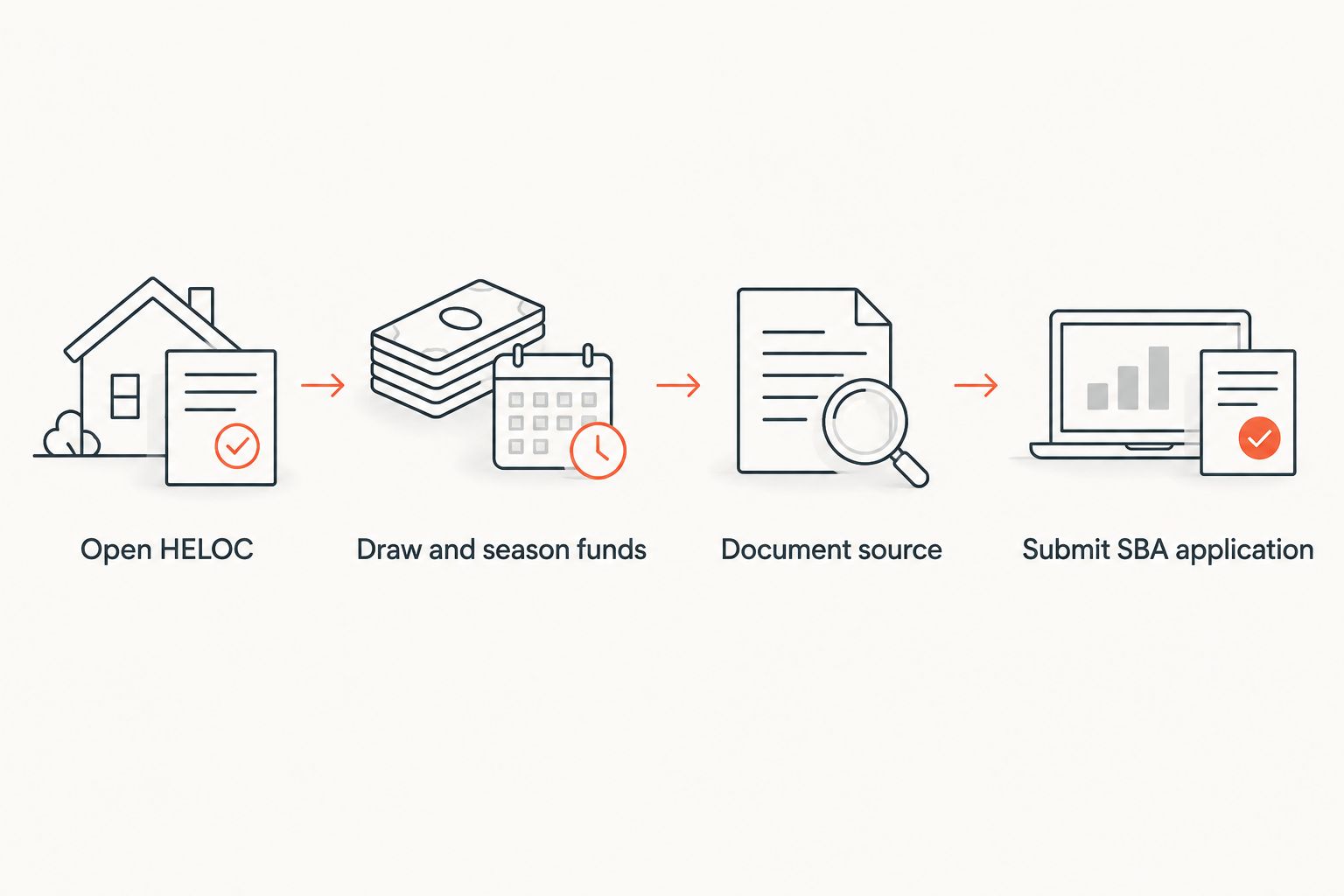
Variant: HELOC as a bridge instead of a down payment
Some candidates use the HELOC differently — not as the equity injection itself, but as a bridge loan to cover deposits, franchise fee installments, or build-out costs while a separate SBA loan or a 401(k) rollover is still processing. In this version:
- Draw the HELOC only when a specific invoice or deposit is due — the franchise fee, a lease deposit, or an equipment down payment.
- Pay it back from the SBA loan proceeds or rollover funds once they land, keeping the HELOC balance temporary rather than permanent.
- Track repayment against your loan closing timeline so the line is cleared before it starts affecting your personal debt-to-income ratio on other applications.
This version works well when your franchise opening date is set but your permanent financing hasn't closed yet — it keeps deposits moving without draining savings you'll need for working capital after opening.
Troubleshooting
The SBA lender flags the deposit as an unexplained large transaction. This means the draw wasn't seasoned long enough. Resubmit with the HELOC statement and source-of-funds letter, and expect the underwriter to ask for an extra 2-4 weeks to re-verify.
Your combined loan-to-value came in lower than expected after appraisal. Home values can shift between your initial estimate and the actual appraisal. If your available credit limit drops, revisit your franchise budget before you commit to a territory deposit you can no longer fully fund.
The lender classifies the HELOC as debt, not equity, and it hurts your debt-to-income ratio. Ask before you draw — some SBA lenders will still accept it as equity if it's seasoned and documented, others won't. Get this answer in writing early, not after your application is already in underwriting.
Interest on the HELOC starts accruing before your franchise generates revenue. Budget the carrying cost into your first-year cash flow projections rather than treating the draw as free money until the studio opens.
Customize your workflow
If you're financing the rest of the investment through an SBA loan, the SBA loan application to opening day workflow walks through what happens after your equity injection is documented — appraisal, environmental review, and the construction draw schedule that follows. Candidates weighing a HELOC against retirement funds should also compare it directly against a 401(k) rollover before locking in either path, since the tax and timing tradeoffs are different.
STRIDE Fitness candidates go through the same qualification steps regardless of how the down payment is funded — the awarding process evaluates net worth, liquid capital, and territory fit, not the specific instrument behind your equity injection.
Talk through your funding path
See how a HELOC-funded down payment fits STRIDE Fitness qualification requirements.
FAQ
What is a HELOC franchise down payment?
A HELOC franchise down payment uses a home equity line of credit to fund the equity injection required to open a franchise, typically 10-15% of the total investment under SBA 7(a) rules. The draw is documented and seasoned before an SBA lender will count it as your own funds.
Can you use a HELOC as the full franchise down payment?
Yes, as long as the HELOC covers the equity injection your SBA lender requires and the funds are seasoned in your account for 60-90 days before you apply. Most candidates draw the full amount upfront rather than splitting it across multiple draws.
How much home equity do you need for a franchise down payment?
You need enough equity that your combined loan-to-value stays under your lender's cap, typically 80-85% including your first mortgage. Work backward from your target equity injection to calculate the home value and existing balance you need.
Is a HELOC or a 401(k) rollover better for a franchise down payment?
A HELOC carries interest and puts your home on the line, while a 401(k) rollover through a ROBS structure avoids early withdrawal penalties but ties retirement funds to the business. The right choice depends on your risk tolerance and how much home equity versus retirement savings you have available in 2026.
Does using a HELOC affect SBA loan approval?
It can, if the draw isn't seasoned or documented properly, since large unexplained deposits trigger extra underwriting scrutiny. Confirm with your SBA lender in advance whether they treat the HELOC as debt or equity in your application.
What happens if home values drop after you draw a HELOC for a franchise?
A drop in home value doesn't cancel an already-drawn HELOC, but it can affect your remaining available credit limit if you need to draw more later. Lock in the amount you need before appraisal volatility becomes a factor.
How long does it take to get a HELOC before franchise financing closes?
Expect 30-45 days to open the HELOC itself, plus another 60-90 days of seasoning before an SBA lender will accept the draw as your equity injection. Start the HELOC application 4-5 months before your target franchise closing date.
Do franchisors care how the down payment is funded?
Most franchisors, including STRIDE Fitness, evaluate candidates on net worth, liquid capital, and territory fit rather than the specific funding instrument. The qualification and awarding process is the same whether the equity injection comes from savings, a HELOC, or a retirement rollover.
One last thing
The seasoning window is the part candidates underestimate every time — a HELOC draw that looks perfectly legitimate to you can still cost you 30-60 days of underwriting delay if it lands in your account the week before you apply. Draw early, document it, and let the calendar do the work.