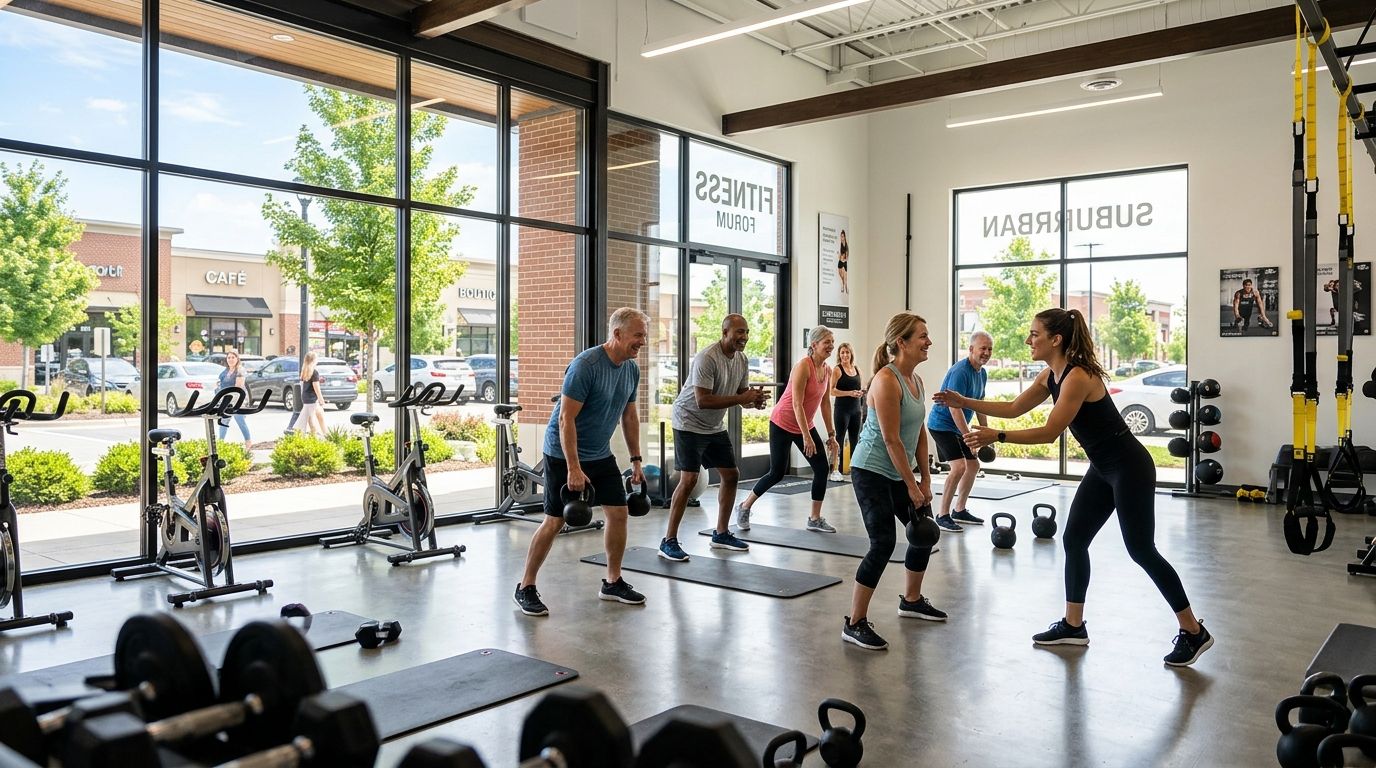

STRIDE Fitness and Crunch Fitness sit at opposite ends of the fitness franchise map: one is a boutique, coach-led studio built for a hands-on owner, the other is a big-box gym built for member volume and scale. Here's how the two systems actually compare for a 2026 investor deciding where to put capital.
- STRIDE Fitness fits investors who want a coach-led boutique studio with a smaller footprint and closer member relationships.
- Crunch Fitness fits investors chasing scale through a big-box, high-membership gym model with decades of brand recognition.
- STRIDE runs candidates through a staged qualification process before a territory is awarded in 2026.
- Neither model is objectively better. The right pick depends on whether you want to run a studio or a mega-gym.
Why this matters
Most people comparing fitness franchises in 2026 start with the biggest, most recognizable name and work backward. That is a mistake if the underlying business model does not match how you actually want to spend your time and capital.
STRIDE Fitness Franchising runs a coach-led treadmill cardio, strength training, and recovery zone concept designed for an owner who wants a defined, boutique studio format. Crunch Fitness runs a large-format, high-volume gym model built on a much bigger membership base per location. Those are two different businesses wearing the same fitness franchise label, and the financial and operational commitments differ accordingly.
At a glance: STRIDE Fitness vs Crunch Fitness
| Dimension | STRIDE Fitness | Crunch Fitness |
|---|---|---|
| Business model | Coach-led boutique studio | Big-box, high-volume gym |
| Studio format | Smaller footprint, class-based | Large-format club, open floor plan |
| Staffing approach | Coaches lead cardio and strength sessions | Self-serve gym floor plus scheduled group classes |
| Target member | Members wanting guided training | Members wanting broad gym access |
| Ownership involvement | Suits hands-on or semi-absentee owners | Suits operators built for scale and staff layers |
| Growth vehicle | Territory-based qualification process | Established multi-unit development in mature markets |
| Standout feature | Built-in recovery zone concept | Amenity breadth in larger clubs |
| Brand history | Newer, boutique-positioned brand | Founded in 1989, decades of name recognition |
STRIDE Fitness wins on coach-led member experience
STRIDE Fitness is built around a coach in the room, not a gym floor left to self-navigation. The format pairs treadmill cardio with strength training and a dedicated recovery zone, so every session has structure and a coach guiding it.
Crunch Fitness, by contrast, is a self-serve gym at its core. Members get access to equipment and a rotating schedule of group classes, but the day-to-day experience is not built around small-group coaching the way STRIDE's format is.
Crunch Fitness wins on brand recognition and member volume
Crunch Fitness has operated since 1989, which means it walks into most markets in 2026 with decades of consumer familiarity that a boutique brand cannot match on day one. That recognition supports the big-box model's core economics: a large-format club depends on a high volume of members moving through the space, not a smaller roster of studio-goers.
STRIDE Fitness competes on positioning instead of tenure. It is a newer, boutique-scale brand built around a specific coached experience rather than broad name recognition.
STRIDE Fitness wins on footprint efficiency
A boutique studio format needs less commercial space than a full-size big-box gym. That translates into a leaner build-out footprint before an investor ever gets to the line-by-line numbers in a Franchise Disclosure Document.
Crunch's larger club format needs more square footage to support its equipment floor, locker rooms, and group class rooms. That is a structurally different real estate commitment than a boutique studio, and it changes both the lease negotiation and the sites you can realistically consider.
Crunch Fitness wins on amenity breadth
The big-box format leaves room for more amenities under one roof than a boutique studio footprint typically carries: a larger free-weight area, multiple group class rooms, and additional wellness add-ons in bigger clubs.
STRIDE Fitness takes a narrower, more intentional approach. Cardio, strength, and one dedicated recovery zone concept rather than a wide amenity menu. See how the recovery zone concept fits into the model.
Both require a serious capital commitment (tie)
Neither system is a low-commitment side project. STRIDE Fitness and Crunch Fitness are both established franchise systems that expect qualified candidates with the net worth and liquid capital to fund build-out and initial operations.
The exact figures live in each brand's current Franchise Disclosure Document. Review that document, line by line, before committing capital in 2026. No comparison article replaces it.
Ownership involvement differs by design (tie, different fit)
STRIDE's boutique format suits an owner who wants a smaller, hands-on operation, or a semi-absentee owner building a portfolio of studio territories. Crunch's big-box format is built to run with a larger staff and more management layers, which suits an operator focused on scale rather than member-facing time on the floor.
Neither approach is wrong. They are built for different kinds of owners.
“The real difference between STRIDE and Crunch is not square footage. It is whether you want to run a big-box club or coach a studio.”
Pricing and investment model: predictability vs scale economics
Both systems follow the standard franchise structure: an upfront franchise fee plus an ongoing royalty, typically calculated as a percentage of gross revenue. What differs is the model those fees support.
STRIDE Fitness runs candidates through a defined, staged qualification process, including Confirmation Day, before a territory is awarded. That gives an investor a predictable path and a clear point where the decision becomes final. Crunch Fitness leans on a more mature, higher-volume system where the economics depend heavily on driving member count inside a bigger facility.
Under the FTC's franchise rule, every Franchise Disclosure Document must be delivered at least 14 days before you sign an agreement or pay a fee. That 14-day clock applies whether you are evaluating STRIDE Fitness, Crunch Fitness, or any other U.S. system in 2026. Use the window to run the numbers, not to skim them.
For a broader read on where STRIDE fits among lower-footprint boutique concepts, fitness franchises under a $500,000 investment is a useful next stop.
See if you qualify for a territory
Start the qualification conversation before your market is claimed.
Final verdict
Choose STRIDE Fitness if you are an investor who wants a boutique, coach-led studio with a smaller build-out footprint, a defined territory-awarding process, and a member experience built around guided training and recovery rather than open-floor self-service. This is the fit for a first-time owner or a career changer who wants a system with clear stages rather than a sprawling facility to manage on day one.
Choose Crunch Fitness if you are an operator built for scale, comfortable running a bigger staff and a larger facility, and drawn to a brand with decades of consumer recognition behind it going into 2026. This is the fit for a multi-unit operator who already knows how to manage large teams and high-traffic locations.
Scorecard recap
| Dimension | Winner |
|---|---|
| Coach-led member experience | STRIDE Fitness |
| Brand recognition and member volume | Crunch Fitness |
| Footprint efficiency | STRIDE Fitness |
| Amenity breadth | Crunch Fitness |
| Capital commitment | Tie |
| Ownership involvement fit | Tie (different investor types) |
| Recovery zone positioning | STRIDE Fitness |
FAQ
Is STRIDE Fitness better than Crunch Fitness for a first-time franchise owner?
It depends on what kind of business you want to run in 2026. STRIDE Fitness suits a first-time owner who wants a smaller, coach-led boutique studio, while Crunch Fitness suits someone ready to manage a bigger facility and a larger staff from the start.
What is the main difference between STRIDE Fitness and Crunch Fitness?
STRIDE Fitness is a coach-led boutique studio built around treadmill cardio, strength training, and a recovery zone. Crunch Fitness is a large-format, self-serve gym built around member volume and broad equipment access.
How much does a fitness franchise cost to open in 2026?
Costs vary by brand, territory, and format, and the exact figures are disclosed in each franchisor's Franchise Disclosure Document. Boutique studio formats generally require a smaller build-out than large-format gym clubs.
Does Crunch Fitness offer coach-led training like STRIDE Fitness?
Crunch Fitness runs scheduled group classes on top of a self-serve gym floor, but coaching is not the core of its format the way it is for STRIDE Fitness. STRIDE builds every session around a coach leading cardio and strength work.
Which franchise model is better for a semi-absentee owner?
A boutique studio format like STRIDE Fitness generally fits a semi-absentee owner better than a large-format gym. The smaller footprint and leaner staffing model require less daily on-site management.
When was Crunch Fitness founded?
Crunch Fitness was founded in 1989. That gives it decades of brand recognition heading into 2026 compared with newer boutique concepts.
What is a recovery zone in a fitness franchise?
A recovery zone is a dedicated area inside a studio set aside for recovery, separate from the cardio and strength floor. STRIDE Fitness builds this into its core concept rather than treating it as an add-on.
How long before signing do I have to review a Franchise Disclosure Document?
Under the FTC's franchise rule, franchisors must deliver the Franchise Disclosure Document at least 14 days before you sign an agreement or pay a fee. That applies to STRIDE Fitness, Crunch Fitness, and every other U.S. franchise system.
One last thing
The decision is rarely STRIDE Fitness versus Crunch Fitness in the abstract. It is whether you want to coach a smaller studio or manage a big-box club with a bigger staff and a bigger membership roster. Answer that question first in 2026, and the rest of the comparison sorts itself out fast.