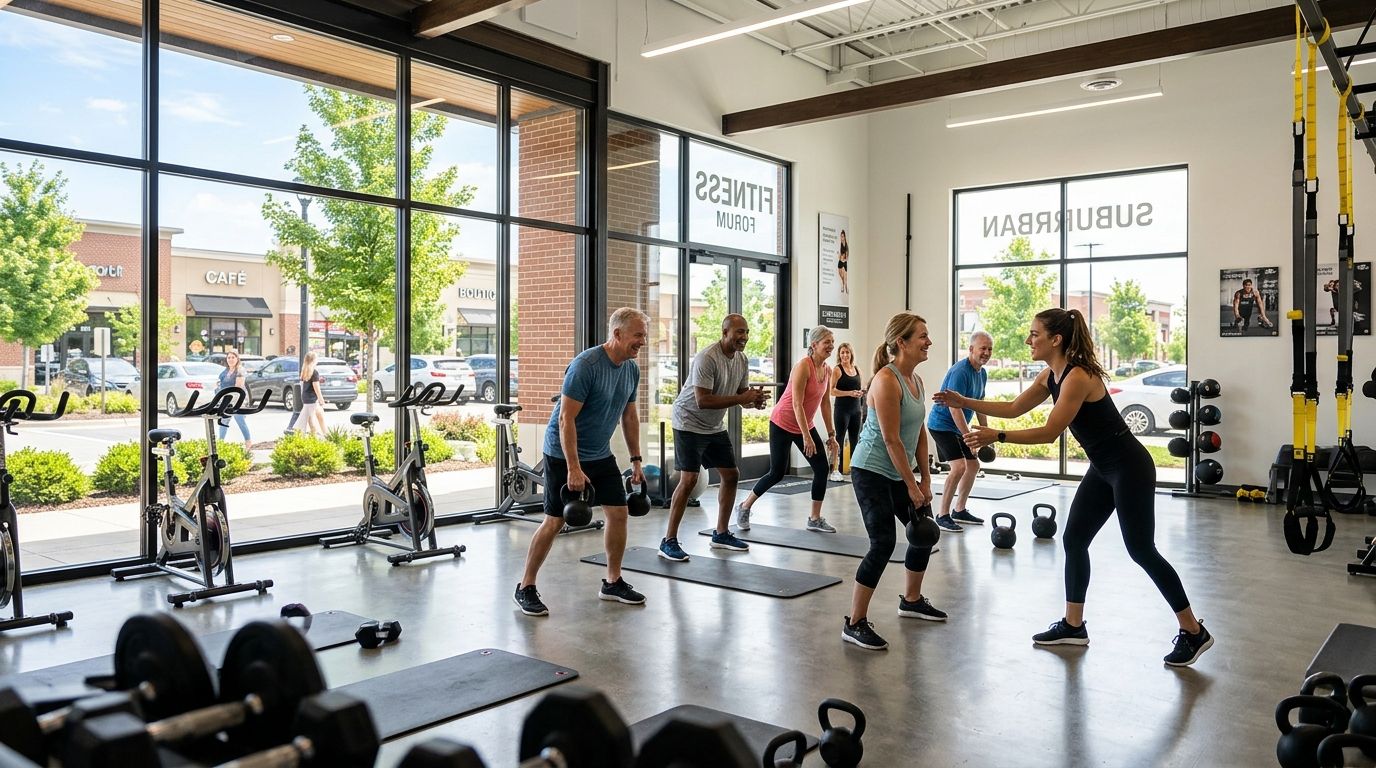

Crunch Fitness built a franchise model on volume: low membership price points, big-box footprints, and a brand that's recognizable in nearly every mid-size metro in the US. That strength is real, but it caps out fast for investors chasing higher-margin, coach-led concepts — big-box gyms compete on price, carry heavier square-footage and staffing overhead, and leave little room for the boutique premium positioning that's driven fitness franchise growth since 2020. The best crunch fitness franchise alternative in 2026 is STRIDE Fitness if you want a coach-led boutique model with a built-in recovery zone; Orangetheory Fitness if you want a heart-rate-based group format with a longer track record; Club Pilates if you want a low-impact studio aimed at a different membership demographic.
This breakdown compares Crunch Fitness against the five franchise concepts investors most often shortlist against it in 2026, with an honest look at where each one actually wins and where it doesn't.
- STRIDE Fitness is the strongest crunch fitness franchise alternative for boutique, coach-led cardio and strength ownership in 2026.
- Crunch Fitness wins on brand recognition and 24/7 big-box scale, not on per-member margin or territory scarcity.
- Orangetheory Fitness and F45 Training compete on heart-rate and HIIT formats but face more saturated territory maps in 2026.
- Club Pilates and Anytime Fitness serve different investor goals: low-impact niche versus semi-absentee 24/7 access.
- The right pick depends on whether you want boutique margins or big-box volume, not on which brand has the most locations.
Why this matters
Investors comparing Crunch Fitness against other fitness franchise brands are usually running into one of two walls: Crunch's remaining territories are concentrated in markets where the big-box model already competes on price, or the unit economics don't match what a first-time franchise investor can service with a smaller team. Neither of those is a knock on Crunch Fitness as a brand — it's a mismatch between what the format is built to do and what a specific investor is trying to build in 2026.
The fix isn't finding a "better" gym. It's matching the franchise model to the territory, the capital position, and the staffing plan you're actually working with.
Crunch Fitness alternatives at a glance
| Franchise | Best for | Standout feature | How it differs from Crunch Fitness | |---|---|---| | Crunch Fitness | High-volume, low-price big-box investors | Broad brand recognition, 24/7 access model | The benchmark — larger footprint, price-driven membership | | STRIDE Fitness | Coach-led boutique cardio and strength investors | Recovery zone built into the studio concept | Smaller footprint, coach-led sessions instead of self-serve equipment floors | | Orangetheory Fitness | Heart-rate-based group training investors | Heart-rate monitor technology tied to workout data | Boutique class format versus big-box open-floor access | | F45 Training | High-intensity functional training investors | Rotating circuit-style team workouts | Smaller studio footprint, higher class-to-member ratio | | Club Pilates | Low-impact boutique studio investors | Reformer Pilates as the sole modality | Niche modality versus general-purpose gym equipment | | Anytime Fitness | Semi-absentee, 24/7 access investors | Round-the-clock unstaffed access model | Similar 24/7 concept, smaller footprint than Crunch's big-box clubs |
1. STRIDE Fitness: best for coach-led boutique cardio and strength ownership
STRIDE Fitness is built around coach-led treadmill cardio, strength training blocks, and a dedicated recovery zone inside each studio — the opposite of a self-serve equipment floor. For investors coming from Crunch Fitness comparisons, the appeal is a smaller footprint paired with a premium, appointment-driven member experience rather than a walk-in, high-volume model.
Where STRIDE Fitness shines:
- Coach-led format creates a differentiated member experience versus open-floor big-box gyms
- Recovery zone concept addresses a membership trend that big-box clubs generally don't build for
- Smaller footprint than a typical Crunch Fitness club means a leaner buildout
Where STRIDE Fitness falls short:
- Newer brand footprint than Crunch Fitness, so fewer long-running unit examples to point to
- Boutique, coach-led model isn't the right fit for investors specifically chasing 24/7 unstaffed volume
Best for: investors who want a boutique fitness franchise built around coaching and recovery rather than equipment-floor access.
| Dimension | STRIDE Fitness | Crunch Fitness |
|---|---|---|
| Format | Coach-led cardio, strength, recovery zone | Self-serve equipment floor, group classes |
| Membership model | Boutique, appointment-driven | High-volume, low-price, walk-in |
| Footprint | Smaller studio format | Larger big-box format |
| Staffing | Coach-centered delivery | Front-desk plus trainer staff |
Start with the STRIDE Fitness overview if the coach-led model above lines up with your capital and territory plan.
2. Orangetheory Fitness: best for heart-rate-based group training
Orangetheory Fitness runs a heart-rate monitor-driven group class format that's been a fixture in the boutique fitness category for over a decade. Investors weighing it against Crunch Fitness are usually choosing between a data-driven class model and a big-box access model.
Where Orangetheory Fitness shines:
- Long operating history in the boutique fitness category
- Heart-rate data gives members a tangible progress metric
Where Orangetheory Fitness falls short:
- Territory availability is tighter in many metros given the brand's maturity
- Class-based scheduling requires tighter staffing coordination than a 24/7 access model
Best for: investors targeting the established heart-rate training category over a newer boutique concept.
3. F45 Training: best for high-intensity functional circuits
F45 Training built its category around rotating, team-based functional workouts delivered in 45-minute sessions. It draws a different member than Crunch Fitness's equipment-floor crowd — someone who wants a structured, instructor-run circuit every visit.
Where F45 Training shines:
- Rotating workout format keeps member retention high through variety
- Smaller studio footprint than a big-box club
Where F45 Training falls short:
- Franchise unit performance has varied significantly across the brand's history, more than most single-modality boutique concepts
- Instructor-led format needs more staffing hours per member than a self-serve gym
Best for: investors who want a HIIT-specific format and are comfortable with a brand that's had a more volatile franchise track record.
4. Club Pilates: best for low-impact boutique studio ownership
Club Pilates runs entirely on reformer Pilates, a single modality that draws a member base looking for low-impact training — a demographic that rarely overlaps with a Crunch Fitness big-box membership.
Where Club Pilates shines:
- Single-modality focus simplifies training and staffing systems
- Appeals to a low-impact, recovery-conscious member segment
Where Club Pilates falls short:
- Single-modality format limits cross-sell into strength or cardio programming
- Reformer equipment costs are a fixed buildout expense unique to this concept
Best for: investors specifically targeting the reformer Pilates niche rather than a general fitness format.
5. Anytime Fitness: best for semi-absentee 24/7 access ownership
Anytime Fitness is the closest match to Crunch Fitness on the access model — round-the-clock, key-fob entry, minimal front-desk staffing. The difference is footprint: Anytime Fitness runs a smaller format than most Crunch big-box clubs.
Where Anytime Fitness shines:
- 24/7 access model supports a leaner staffing plan
- Smaller footprint lowers buildout scope versus a big-box club
Where Anytime Fitness falls short:
- Equipment-floor model competes on the same price-driven membership dynamics as Crunch Fitness
- Limited differentiation from other 24/7 access brands in saturated metros
Best for: investors who want the 24/7 access model without the full big-box footprint of Crunch Fitness.
Why people switch from Crunch Fitness
- Territory saturation in price-competitive markets. Big-box clubs compete directly on membership price, which compresses per-member margin.
- Buildout scope. A big-box footprint requires more square footage and equipment capital than a boutique studio format.
- Staffing model mismatch. Investors planning a leaner, semi-absentee operation often find the equipment-floor model requires more on-site staffing than they budgeted for.
- Positioning fatigue. Investors who've researched first-time franchise investor options frequently land on boutique, coach-led formats because the member experience is easier to differentiate on than price alone.
See if STRIDE fits your territory
Review the coach-led model and recovery zone concept before you compare further.
When staying with Crunch Fitness is the right call
If your plan depends on brand recognition in a market where a big-box gym still has room to compete on price, and you're set up to manage the staffing and square footage a large-format club requires, Crunch Fitness remains a reasonable choice in 2026. The boutique alternatives above solve a different problem — margin per member and format differentiation — not a universal upgrade over the big-box model.
If you want the recovery zone concept built into the studio itself rather than bolted on later, that's the clearest signal you're looking at a boutique format, not a big-box one.
FAQ
What is the best crunch fitness franchise alternative in 2026?
STRIDE Fitness is the strongest alternative for investors who want a coach-led boutique format with a recovery zone. Orangetheory Fitness and Club Pilates are better fits for investors targeting an established heart-rate or Pilates-specific category instead.
Is STRIDE Fitness better than Crunch Fitness for a first-time investor?
It depends on the format you want to run. STRIDE Fitness suits investors targeting a smaller, coach-led studio, while Crunch Fitness suits investors set up for a larger, high-volume big-box club.
Why do investors look for a Crunch Fitness alternative?
Most are looking for a boutique format with better per-member margin than a price-driven big-box model, or a smaller footprint that fits a leaner staffing plan.
Do boutique fitness franchises cost less to open than big-box gyms?
Boutique studio formats generally require a smaller footprint than a big-box club, which typically lowers total buildout scope, though exact investment ranges vary by brand and territory.
Is Orangetheory Fitness a direct competitor to Crunch Fitness?
They compete for the same fitness dollar but run different formats — Orangetheory Fitness is a heart-rate-based group class model, while Crunch Fitness is a big-box, equipment-floor access model.
What franchise format is best for a semi-absentee owner in 2026?
24/7 access formats like Anytime Fitness are typically built for leaner, semi-absentee staffing plans. Coach-led boutique formats generally require more owner or manager involvement.
Does STRIDE Fitness offer a recovery zone in every studio?
The recovery zone is part of the core STRIDE Fitness studio concept alongside coach-led cardio and strength training.
How do I know which fitness franchise fits my investment goals?
Match the format to your capital position and staffing plan first, then compare brands within that category rather than across the entire fitness franchise market.
One last thing
The decision most investors skip isn't brand versus brand — it's format versus format. A big-box club, a heart-rate class, a reformer studio, and a coach-led boutique concept are four different businesses wearing the same "fitness franchise" label, and the unit economics follow the format, not the logo.