
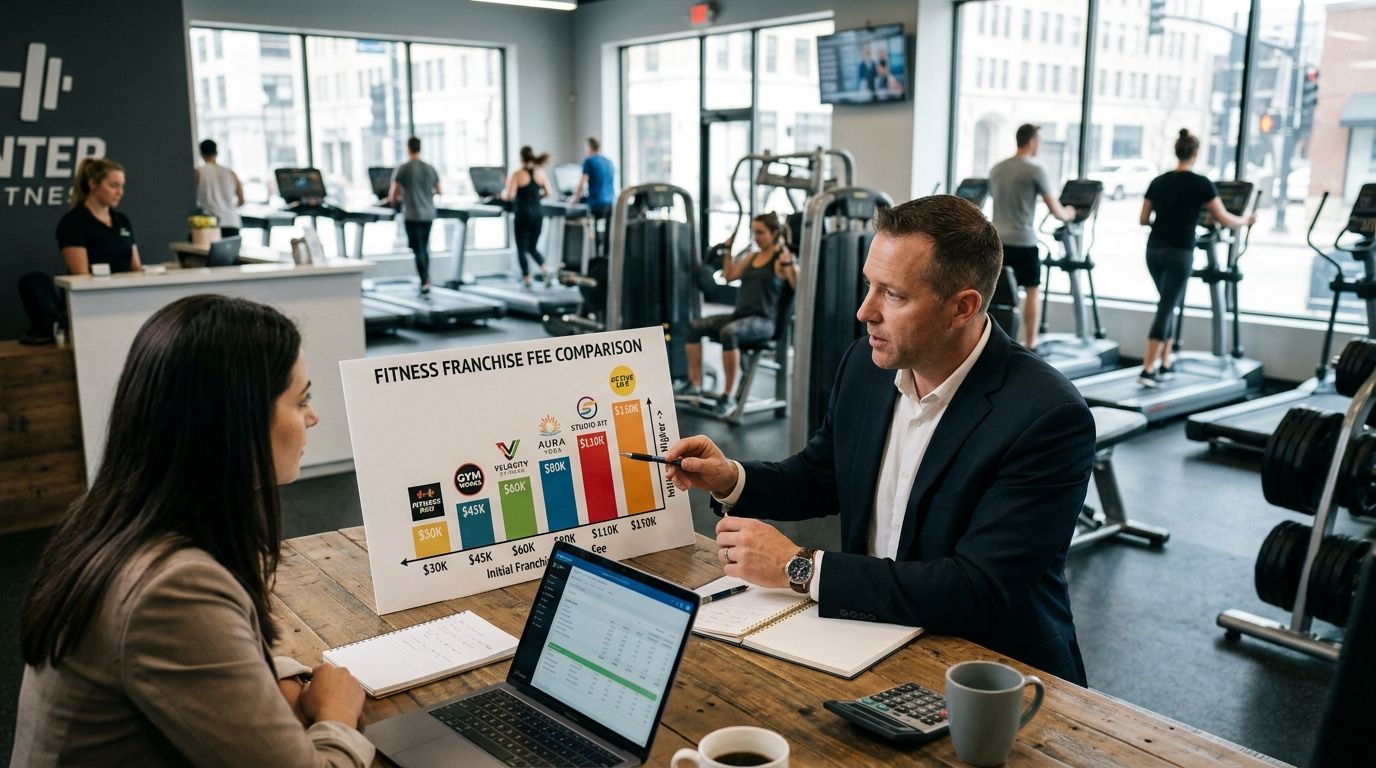
Franchise fees for fitness concepts vary by investment tier, not by hype — and the fee itself is only one line in a total investment that also covers build-out, equipment, and working capital. This comparison ranks fitness franchise opportunities by the investment bracket their franchise fee sits in, so you can match your capital to the right tier before you ever talk to a franchisor.
- Fitness franchise fee comparison for 2026 sorts brands into four investment tiers, not a single price list.
- Under-$250,000 tier fits first-time, single-unit investors who want the lowest entry point.
- STRIDE Fitness sits in the $250,000-$500,000 boutique studio bracket built for owner-operators.
- Multi-unit and semi-absentee tiers demand more liquid capital but scale faster per territory.
- The franchise fee is rarely the biggest number in your total investment — build-out usually is.
Why this matters
Most buyers shop franchise fee like it's the price tag on the whole business. It isn't. The initial franchise fee buys you the brand system, training, and territory rights — the bulk of your capital goes to real estate, equipment, and opening costs that sit in a separate line of the Franchise Disclosure Document.
In 2026, fitness franchising is still splitting into distinct buyer profiles: the first-time single-unit owner, the boutique studio operator, and the multi-unit investor building a portfolio. Ranking fitness franchises by fee bracket instead of brand name matches how qualified candidates actually get awarded territories — by capital fit first, brand fit second.
What makes the best fee tier for you
- Total investment range, not just the initial fee — franchise fee plus build-out, equipment, and opening capital
- Territory size and exclusivity — how much market a single award covers
- Ongoing royalty and marketing fund structure — the recurring cost after you open
- Owner involvement model — coach-led, owner-operator, or semi-absentee with a general manager
- Multi-unit discount availability — whether a second or third territory costs less to add
- Support and training depth — what the franchisor covers during pre-opening and after Confirmation Day
Fitness franchise fee tiers at a glance
| Tier | Best for | Standout feature | Key consideration |
|---|---|---|---|
| $250,000–$500,000 boutique studio | Owner-operators wanting a single territory | Coach-led format with a differentiated add-on service | Requires more liquid capital than a storefront under $250,000 |
| Under $250,000 | First-time, single-unit investors | Lowest capital bar to get to Confirmation Day | Smaller territory economics limit upside without expansion |
| Multi-unit / semi-absentee | Operators scaling past one territory | Economies of scale on marketing and staffing | Success depends heavily on the general manager hire |
| Niche and group-format | Coaches converting to specialty ownership | Narrow, easy-to-market modality | Revenue ceiling if the format's popularity cools |
1. $250,000–$500,000 boutique studio tier: best for owner-operators
This bracket covers boutique studio concepts built around a specific training method plus a secondary service. STRIDE Fitness sits here: coach-led treadmill cardio, strength training, and a recovery zone under one roof, sized for a single owner-operator territory rather than a portfolio play.
STRIDE Fitness pros:
- Three revenue lines (cardio, strength, recovery) instead of one modality
- Territory-based model built for direct owner involvement, not absentee management
- Coach-led format gives members a reason to return beyond a treadmill class
STRIDE Fitness cons:
- Requires more liquid capital than a sub-$250,000 storefront concept
- Not structured as a semi-absentee model — the owner is expected to be present
- The recovery zone add-on needs more square footage than a single-format studio
Best for: owner-operators who want to run the studio themselves and want more than one revenue line. Verdict: Buy if your capital and your calendar both fit an owner-operator model.
2. Under $250,000 tier: best for first-time investors
The lowest capital bracket in fitness franchising, typically smaller footprints and single-modality formats — a spin studio, a bootcamp concept, a niche group class brand. Lower entry means a faster path to signing, but the territory economics are thinner too.
Under-$250,000 tier pros:
- Smallest capital bar of any tier, easiest first step into franchise ownership
- Faster build-out timeline than multi-service concepts
- Lower breakeven membership count in most single-modality formats
Under-$250,000 tier cons:
- Ceiling on unit economics without adding a second territory later
- Thinner margin cushion if local competition undercuts on price
- Fewer revenue lines than a multi-service studio concept
Best for: a candidate testing franchise ownership for the first time with limited liquid capital. Verdict: Buy for a first territory, Wait before assuming a second unit pencils the same way.
3. Multi-unit / semi-absentee tier: best for scaling operators
This bracket bundles two or more territories, or structures a single territory around a hired general manager instead of an owner behind the front desk. It's the tier for an investor who wants unit economics at scale, not a single studio to run personally.
Multi-unit tier pros:
- Marketing and staffing costs spread across multiple territories
- Faster territory lock-up in a target market before a competitor moves in
- Fits investors who don't want to coach or manage day-to-day
Multi-unit tier cons:
- Requires the largest liquid capital and net worth commitment of any tier
- Semi-absentee success rides entirely on the general manager hire
- Slower per-unit breakeven while a second and third territory ramp up
Best for: an investor with existing business management experience and capital to fund more than one territory. Verdict: Buy if you already have a general manager candidate lined up; Hold if you don't.
4. Niche and group-format tier: best for specialty coaches
Covers single-modality concepts — running-focused training, a specific group class format — where the franchise fee buys into one narrow, well-defined method. It's an easy story to market locally, but it's also the tier most exposed to a fitness trend cooling off.
Niche tier pros:
- Simple, easy-to-explain positioning in a local market
- Appeals to coaches or instructors already known for the modality
- Lower overhead than a multi-service studio in most cases
Niche tier cons:
- Revenue capped by one modality with no natural add-on service
- More exposed to a format losing popularity than a multi-service concept
- Harder to cross-sell recovery or strength add-ons later
Best for: a candidate with existing credibility in one training method who wants to own that niche locally. Verdict: Hold unless you already have a built-in member base in that modality.
How this tier ranking was built
Each tier was ranked against the same six criteria: total investment range, territory exclusivity, royalty structure, owner involvement model, multi-unit discount availability, and support depth. The order runs from the bracket that fits the widest pool of owner-operators down to the narrowest specialty play — not from cheapest to most expensive.
See which tier fits your capital
Check current territory availability and next steps.
Which fitness franchise fee tier should you choose?
If you're a first-time buyer with limited liquid capital, the under-$250,000 tier is the honest starting point in 2026 — smaller territory, faster path to opening, thinner upside. If you want to be the owner-operator behind the counter with more than one revenue line, the $250,000–$500,000 boutique studio tier — where STRIDE Fitness sits — fits better than a single-modality concept. If you're funding a portfolio and already have management experience, the multi-unit tier is the only bracket built for that math.
The undecided reader should default to matching their liquid capital to the tier first, then evaluating brand fit within that tier — capital mismatch, not brand choice, is what stalls most franchise applications before Confirmation Day.
FAQ
What is a typical fitness franchise fee compared to total investment?
The franchise fee is one line item in a total investment that also includes build-out, equipment, and opening capital, and it's usually the smallest of the three. Check a brand's Franchise Disclosure Document Item 7 for the full breakdown before comparing fees alone.
Is a lower franchise fee always the better deal?
No — a lower fee often pairs with a smaller territory and thinner unit economics. Compare the fee against territory size and support depth, not the fee alone.
What's the best fitness franchise fee tier for a first-time investor?
The under-$250,000 tier is built for first-time, single-unit buyers with limited liquid capital in 2026. It trades a lower entry point for smaller territory economics.
Does multi-unit ownership change how the franchise fee works?
Multi-unit and semi-absentee tiers often bundle territory awards, which changes the capital math per unit even when the per-territory fee structure stays similar. The bigger shift is in staffing and management cost, not the fee itself.
Can you run a fitness franchise semi-absentee?
Yes, but it depends on hiring a general manager who runs day-to-day operations, and success in that model rests almost entirely on that hire. Owner-operator concepts like STRIDE Fitness are structured differently, for an owner who's present.
What investment tier does STRIDE Fitness fall into?
STRIDE Fitness sits in the $250,000-$500,000 boutique studio bracket, built for an owner-operator running coach-led cardio, strength training, and a recovery zone in one territory.
What does a fitness franchise fee actually cover?
It covers the license to use the brand system, initial training, and territory rights, not the build-out or equipment. Those costs sit separately in the total investment figure.
How is a boutique studio franchise fee different from a big-box gym franchise fee?
Boutique studio concepts generally sit in a narrower investment bracket tied to a smaller footprint and specific format, while larger gym concepts scale their total investment with square footage. Compare both against territory size, not the fee alone.
One last thing
The franchise fee is almost never the number that decides whether you can afford a territory in 2026 — build-out and opening capital usually dwarf it. Before ranking brands by fee, pull the full total investment range from each brand's Franchise Disclosure Document Item 7, because that's the number that actually determines which tier fits your liquid capital.