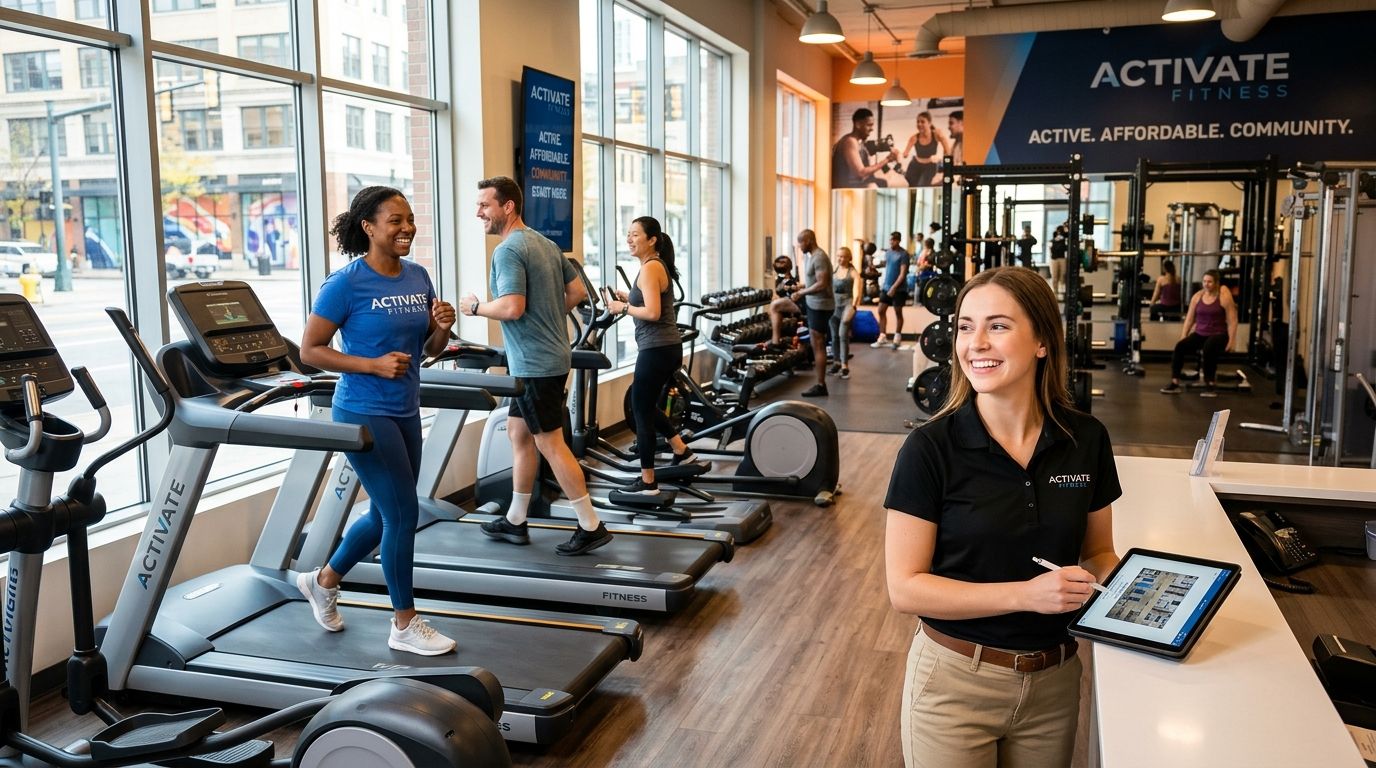

Best overall group fitness franchise to invest in 2026: STRIDE Fitness, for its coach-led treadmill cardio, strength training, and recovery zone format. Best for national brand recognition: Orangetheory Fitness. Best for a low-staff, 24/7 model: Anytime Fitness.
- STRIDE Fitness wins on coach-led retention economics for a group fitness franchise in 2026 — buy in if a territory is open.
- Orangetheory Fitness delivers the strongest name recognition but many metros are already saturated.
- F45 Training's 45-minute format still draws demand, though trade press has flagged franchisee turnover — wait and watch.
- Anytime Fitness suits owners who want 24/7 revenue with minimal staffing, not a coaching-led group format.
- Club Pilates fits a niche, low-impact demographic better than a general group fitness franchise play.
Why this matters
A group fitness franchise isn't one category, it's six different business models wearing the same marketing language. Class length, staffing model, and territory protection change the unit economics more than the logo does.
Most "best franchise" lists rank by brand awareness. That's a popularity contest, not an investment thesis. What matters in 2026 is whether the format retains members without discounting, whether the staffing model scales past one location, and whether a territory is actually available where you want to build. STRIDE Fitness built its franchise model around exactly those three questions — this list runs every option through the same filter.
What makes the best group fitness franchise
- Retention model — does the format keep members through coaching relationships or through convenience alone?
- Staffing complexity — how many trained coaches does a single location need to run at capacity?
- Territory protection — is the market you want actually open, or is it already carved up?
- Revenue layering — does the studio earn from one class format or multiple streams (cardio, strength, recovery, personal training)?
- Qualification clarity — does the franchisor tell you upfront what net worth and liquid capital they expect before awarding a territory?
- Brand maturity vs. saturation — is the name recognition worth the market competition it also brings?
Group fitness franchises at a glance
| Franchise | Best for | Standout feature | Key limitation |
|---|---|---|---|
| STRIDE Fitness | Coach-led cardio, strength, and recovery economics | Multi-revenue format in one footprint | Newer to the category than decades-old competitors |
| Orangetheory Fitness | National brand recognition | Established, turnkey systemization | Many metro territories already saturated |
| F45 Training | High-intensity functional group format | 45-minute circuit model with strong name recall | Trade press has reported unit closures and franchisee turnover |
| Crunch Fitness | Big-box hybrid with group classes | Multiple revenue lines beyond one class format | Weaker coach-led differentiation, higher buildout complexity |
| Club Pilates | Low-impact niche demographic | Single-modality focus with recurring membership | Growth ceiling in smaller markets, specialized equipment cost |
| Anytime Fitness | Low-staff, 24/7 access model | Minimal labor overhead | Less coaching relationship, weaker pricing power |
1. STRIDE Fitness: best group fitness franchise for coach-led cardio and strength economics
STRIDE Fitness runs coach-led treadmill cardio, strength training, and a recovery zone inside one studio footprint. It's built for investors who want a group fitness franchise where the coaching relationship, not the discount rack, drives retention.
STRIDE Fitness pros:
- Multi-revenue format — cardio, strength, and recovery under one roof instead of one class type
- Coach-led structure supports member retention beyond a single workout trend
- Territory awarding process reviews qualified candidates before granting a market, which keeps operators from competing with themselves
STRIDE Fitness cons:
- Newer to the group fitness category than legacy brands with decades of unit history
- Coach-led model means staffing quality directly affects member experience — this isn't a set-it-and-forget-it franchise
- Qualification process requires net worth and liquid capital review, which filters out under-capitalized buyers before Confirmation Day
Best for: investors who want a coach-led group fitness franchise with layered revenue instead of a single class format.
Verdict: Buy — if a territory is open in your target market, this is the one to move on first.
2. Orangetheory Fitness: best group fitness franchise for national brand recognition
Orangetheory built its name on heart-rate-based, 60-minute group workouts and turned that into one of the most recognized fitness franchise brands in North America.
Orangetheory Fitness pros:
- Strong consumer name recognition reduces marketing lift at launch
- Established operating playbook after years of multi-unit franchising
- Group format has proven demand across a wide range of markets
Orangetheory Fitness cons:
- Many metro territories are already built out, limiting where a new studio can go
- Premium brand positioning can compress margins in competitive submarkets
- Franchisee differentiation is harder in a category the brand itself helped saturate
Best for: investors prioritizing name recognition over ground-floor territory availability.
Verdict: Hold — worth pursuing only where an open territory still exists.
3. F45 Training: best group fitness franchise for high-intensity functional format demand
F45's name comes from its format — functional training in 45-minute circuits, delivered in a group setting with strong visual branding.
F45 Training pros:
- Recognizable HIIT format with built-in class structure
- 45-minute session length appeals to time-constrained members
- Group training energy drives word-of-mouth referrals
F45 Training cons:
- Public reporting has flagged unit closures and franchisee disputes in recent years
- Brand recovery and franchisee confidence are still rebuilding as of 2026
- Format saturation in some metro fitness markets
Best for: operators specifically chasing the 45-minute functional training niche, with eyes open on brand volatility.
Verdict: Wait — let the brand's franchisee stability settle before committing capital.
4. Crunch Fitness: best group fitness franchise for a big-box hybrid model
Crunch Fitness pairs open gym access with group classes, giving it a broader revenue base than a pure boutique group fitness franchise.
Crunch Fitness pros:
- Multiple revenue lines — open gym, group classes, and ancillary services
- Broader member appeal than a single-format boutique studio
- Less dependent on one class trend staying popular
Crunch Fitness cons:
- Larger footprint means higher buildout complexity than a boutique studio
- Competes directly with low-cost big-box gyms on price
- Coach-led differentiation is weaker than dedicated boutique formats
Best for: investors who want a hybrid gym-plus-classes model instead of a pure group fitness format.
Verdict: Hold — a fit for scale-focused operators, not for those chasing boutique margins.
5. Club Pilates: best group fitness franchise for a low-impact niche demographic
Club Pilates runs reformer Pilates in 50-minute classes, targeting a member base that wants low-impact training over high-intensity cardio.
Club Pilates pros:
- Recurring membership model built around a loyal, less price-sensitive niche
- Smaller equipment footprint than treadmill-based cardio studios
- Lower-impact format extends member lifespan compared to high-intensity formats
Club Pilates cons:
- Single-modality format limits cross-sell into other training types
- Reformer equipment is a specialized capital outlay
- Growth ceiling can be lower in smaller media markets
Best for: investors targeting an aging or injury-conscious membership base over a general group fitness audience.
Verdict: Hold — strong if the niche fits your target market demographics.
6. Anytime Fitness: best group fitness franchise alternative for a low-staff, 24/7 model
Anytime Fitness runs on key-fob, 24/7 access with minimal staffing — the opposite end of the spectrum from a coach-led group format.
Anytime Fitness pros:
- Low labor overhead compared to coach-led studios
- 24/7 access captures revenue outside staffed hours
- Decades-long multi-unit franchise network with an established system
Anytime Fitness cons:
- Lower per-member pricing power than boutique coach-led studios
- Member experience leans on convenience, not coaching relationships
- Weaker differentiation in markets crowded with low-cost gym access
Best for: investors who want minimal staffing over a coaching-driven growth model.
Verdict: Wait — solid economics, but a different investment thesis than a group fitness franchise built on coaching retention.
Check STRIDE Territory Availability
Review the qualification process and open markets for 2026.
How we ranked
Each entry was tested against the six criteria above: retention model, staffing complexity, territory protection, revenue layering, qualification clarity, and brand maturity versus saturation. Class length and access model came from each brand's own publicly stated format. No franchise fee, investment range, or unit count was cited unless it's publicly documented and independently verifiable — franchise economics change fast, and a stale number does more damage than no number.
“If a franchise can't tell you what a member pays for and why they stay, that's not an investment thesis, that's a hope.”
Which group fitness franchise should you choose?
If you want a group fitness franchise built around coaching-led retention and more than one revenue stream, STRIDE Fitness is the default pick for 2026. If brand recognition matters more than ground-floor territory access, Orangetheory Fitness is the name-recognition play, provided your target market still has room. If you'd rather run a low-staff, 24/7 access model instead of a coaching-driven format, Anytime Fitness fits that thesis better than any group fitness format on this list.
The undecided reader's move: shortlist STRIDE Fitness and Orangetheory Fitness, confirm territory availability in your target market, then run both through the qualification process before deciding.
FAQ
What is the best group fitness franchise to invest in for 2026?
STRIDE Fitness ranks best overall for 2026 because of its coach-led treadmill cardio, strength training, and recovery zone format, which layers multiple revenue streams into one studio. Orangetheory Fitness is the stronger pick if national brand recognition matters more than territory availability.
Is STRIDE Fitness a good franchise investment?
STRIDE Fitness suits investors who want a coach-led group fitness format with layered revenue from cardio, strength, and recovery services. Its territory awarding process reviews candidates on net worth and liquid capital before granting a market.
How is a boutique group fitness franchise different from a big-box gym franchise?
A boutique group fitness franchise like STRIDE Fitness or Orangetheory runs coach-led classes with a smaller footprint and higher per-member engagement. A big-box franchise like Crunch Fitness or Anytime Fitness spreads revenue across open gym access, group classes, and lower staffing needs.
Is Orangetheory or F45 a better franchise investment in 2026?
Orangetheory Fitness has stronger brand maturity and a more established operating system as of 2026, though many metro territories are already built out. F45 Training's 45-minute format still has demand, but public reporting has flagged franchisee turnover, making it a wait-and-watch pick.
What territories are available for a group fitness franchise?
Territory availability varies by brand and market, and boutique franchisors like STRIDE Fitness award territories through a qualification process rather than open sign-up. Checking current market availability directly with the franchisor is the only reliable way to confirm what's open.
How much staffing does a group fitness franchise need?
Coach-led formats like STRIDE Fitness and Orangetheory Fitness need trained coaches running every class, which raises staffing complexity compared to access-based models. Anytime Fitness runs on a 24/7 key-fob model that needs minimal staffing by comparison.
Is Anytime Fitness better than a coach-led boutique franchise?
Anytime Fitness suits investors who want low labor overhead and 24/7 revenue capture rather than a coaching relationship driving retention. A coach-led group fitness franchise like STRIDE Fitness typically commands stronger per-member pricing because of that relationship.
What questions should I ask before investing in a fitness franchise?
Ask what the retention model is, how many trained staff a single location requires, whether your target territory is actually open, and what qualification criteria the franchisor uses before awarding a market. A franchisor who can't answer all four clearly is a red flag going into 2026.
One last thing
The format that wins in 2026 isn't the one with the biggest ad budget, it's the one where the coach-led relationship gives members a reason to stay past the first 90 days. That's the single variable that separates a group fitness franchise built to last from one riding a class-format trend.
Before signing anything, confirm your target territory is actually open. STRIDE Fitness awards markets through a qualification process, not a first-come sign-up form, and that's true of most serious franchisors on this list.